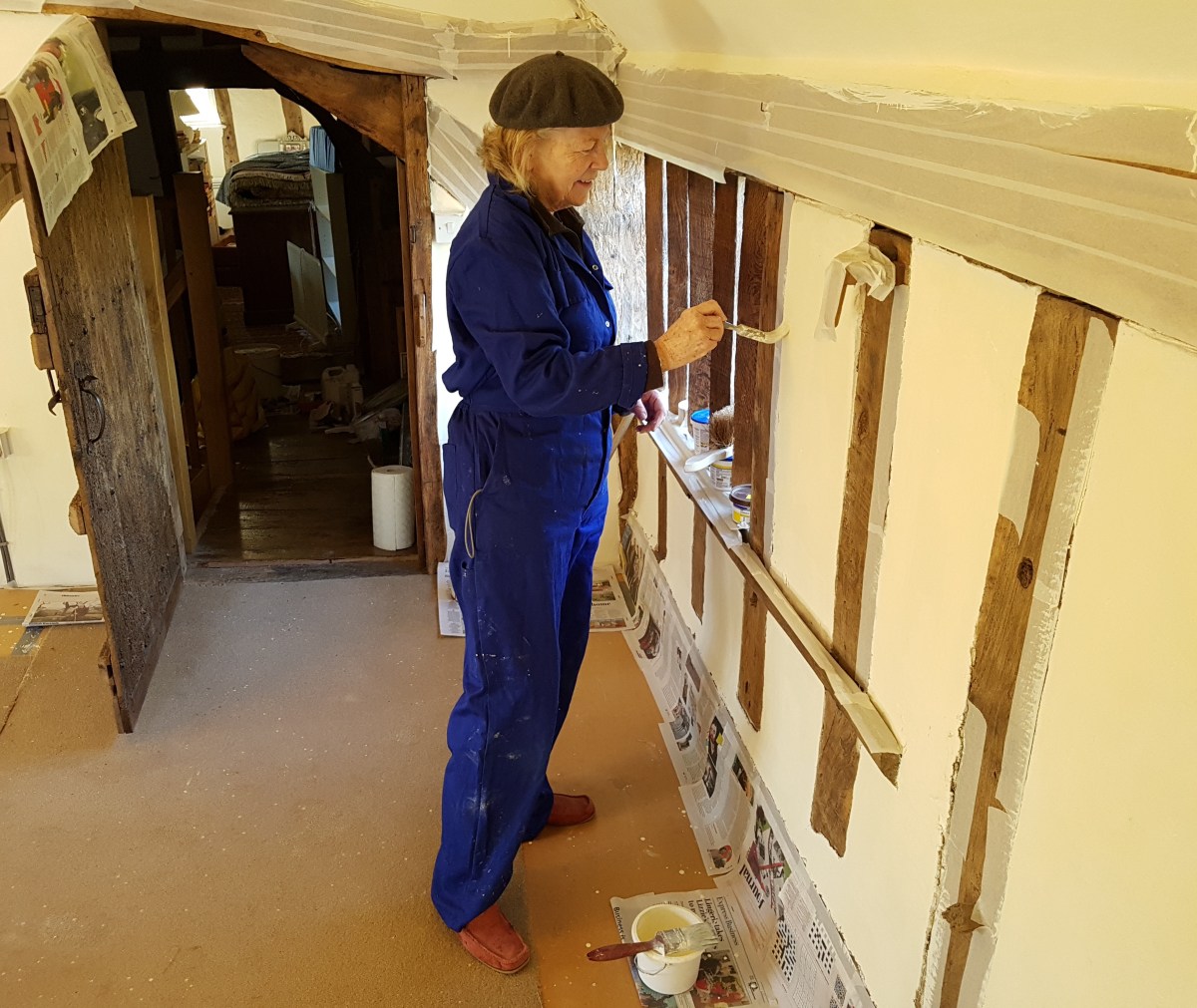
According to one Suffolk expert, limewash was not used inside homes. If true, then we’ve been doing it wrongly for years. Instead distemper made from chalk and milk casein is said to have been the covering of choice, so this winter we’ve tried it. Continue reading “Distemper”
I’ve been wondering how best to redecorate a room whose surfaces are finished in old materials – clay and plaster – but which have been painted with modern emulsion. That may be creating a breathability problem.
Very modern emulsions are impermeable to moisture. Cruder basic emulsions have a certain amount of breathability, but it’s hard to tell which it is, looking at the result at least 30 years after it was last painted. So should the emulsion be removed? Continue reading “Limewash over emulsion paint “
Just discovered a disadvantage of shallow brick footings: a large rat managed to tunnel right under them and up inside where the water and waste pipes enter and leave the building.
Caught the rat with an electronic trap and filled the hole down to the bottom of the footings with a couple of buckets of limecrete, using lime, sand and gravel.
Had to do it twice more because another rat twice bypassed the limecrete by digging a longer tunnel, partially removing the still soft limecrete as it went. Continue reading “Rat assault “
It has been a positive pleasure painting the windows in the last few days using custom-mixed linseed oil paint from Ingilby’s of Glemsford. The window frames were stripped and repaired, and much of the putty renewed, some time ago, and they have since been given several coats of pure linseed oil to prepare and waterproof them. But for various reasons, I didn’t get round to completing the job.
Now I’m painting, I can immediately see the benefits of using linseed oil on old wood. Where I’ve left a leading edge of paint on bare wood, the oil spreads out of the paint into the wood, which seems to lap it up, almost pickling the timber in oil. That can only be good for long term preservation, especially as absorption is helped by the slowness with which the paint dries. Continue reading “Old fashioned paint”
The first step is to prepare some of our grey boulder clay, which we saved from the excavations for the extension. It is much better than the brown clay we used previously when we bought ready mixed daub from a farm in Essex.
Went on holiday for 3 weeks, leaving the clay daub repairs till afterwards (see earlier post) – and this is what the woodpeckers have done to the bare patch, digging for insects while the house was empty. One of the holes is six inches deep. Won’t leave repairs so long next time…
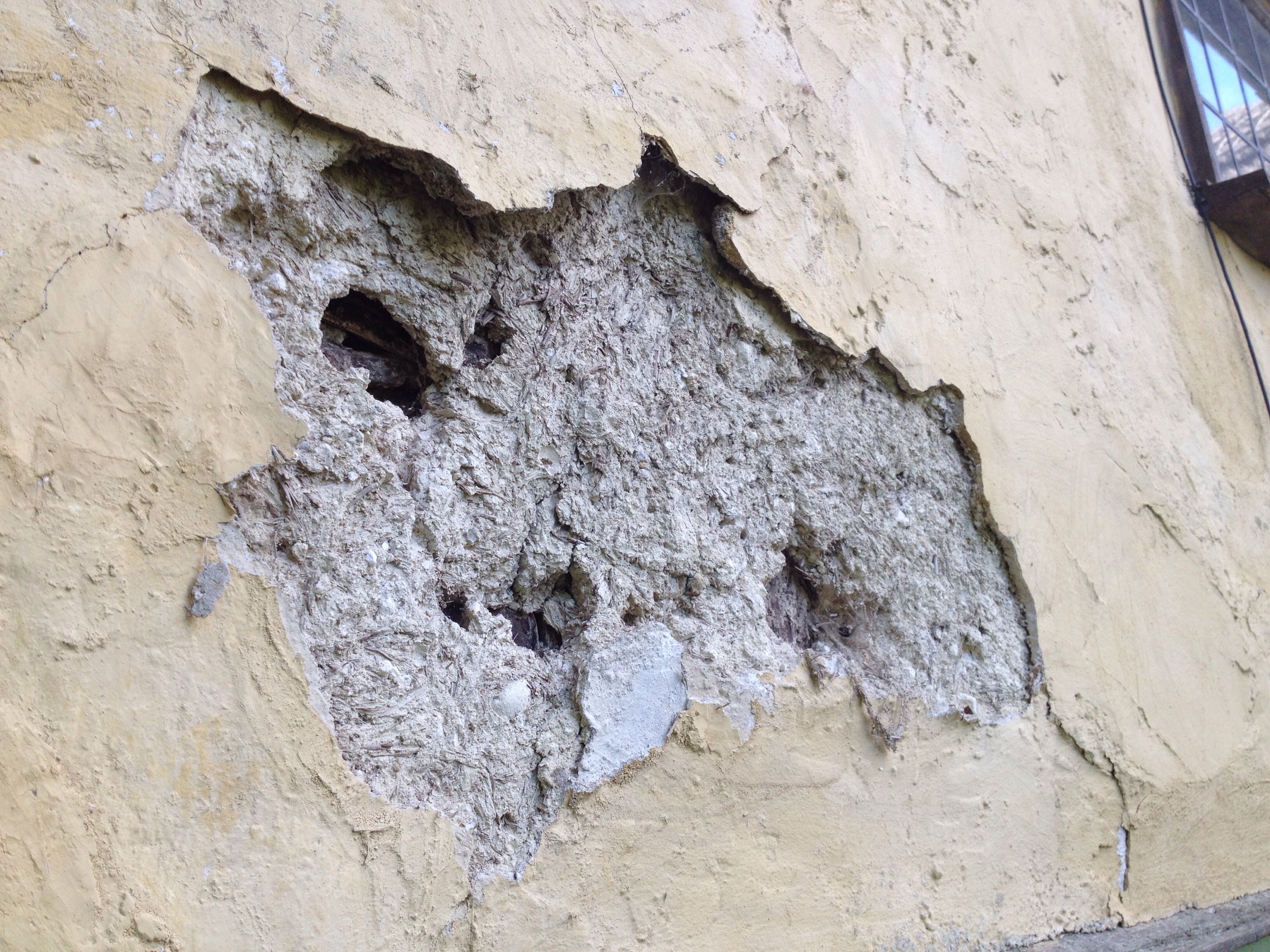
After focusing on a new timber framed extension for so long, we’re now back to repairing the old building. Weak bits of of a rough cement render have been dropping off the front wall, as the picture shows. The cement is just a thin layer skimmed a few decades ago onto clay daub.
We’ve been expecting this, but took a decision early on to let it happen by natural weathering, and then patch repair bit by bit. Looking at the evidence of what’s there, we think patching is the way the walls have been maintained for a very long time – any weakness, then they just slapped on a bit of clay and limewashed it, and owners only recently took to adding cement as well. Continue reading “Back to daub”
I gather that there is questioning among some East Anglian lime specialists of the claim reported in the previous post that traditional hair mixes are significantly prone to failure.
As I mentioned, this is not about the well known deterioration of hair if it is left too long in a wet mix before being used, but about intrinsic faults in the hair, especially if it is imported. Continue reading “PS on lime”
I have to admit now that I have been a bit nervous about our new chalk lime plaster since last August, though I haven’t confessed it so far to the blog: we used imported pigs hair for the plaster in 2013, and more than a year after it was done I was speaking to another lime specialist who gave a deep intake of breath, frowned, and asked: has it fallen off yet? He seemed to relish recounting the story of another Suffolk house where the pig hair had disintegrated and the plaster coat had failed in the first year, on his version of the story because it had a foreign bug that had eaten it.
I’m now much more confident that our pig hair plaster is OK. There are no signs of failure, and from time to time over the autumn I pulled out a bit of hair near the surface and checked it for strength. I tried again this morning and the hair was as strong as ever. Continue reading “Lime developments”
One of the conditions for listed building consent was that the colour of the extension must match the yellow ochre limewash of the old building, so the simplest way to do that would be to use the same limewash mix again. Hollins, the architects, instead specified Keim in the listed building consent application, a mineral paint which has been on the market for well over 100 years, and was developed in Bavaria as a more durable substitute for limewash. I’d never heard of it before, but a web search shows it is widely known.
We’re using lime plaster to finish the outside walls. Lime is a fairly recent revival as a building material, and people are re-learning the old trades as they go, so there are still a lot of disagreements about the best way to do things. It’s not yet Lime Wars, but there are regular skirmishes.
Lime plastering a gable
As we’ve noted before, the Essex way (as taught on a course we attended near Braintree) was to use lime and sand as a hard render on the outside of a wattle and daub house. We repaired a wall like that, only to be told off a year later by a local Suffolk expert: the true vernacular coating in Suffolk was a plaster made from chalk, hair and lime, which is tougher and more flexible. Continue reading “Back to tradition – lime plaster”
The more I look at the way our modern extension is being built, the more I am convinced that it is a fitting companion to the original 16th century oak-framed house. There is not a great deal of difference between the basic structural concepts, and only the materials and methods of fixing are new.
The biggest difference is that an old oak frame is mortised and tenoned rigidly with a few very heavy timbers while a modern softwood frame uses more but lighter timbers fixed with nails and steel hangers, and plywood sheets to increase rigidity. A modern construction can also use some big timbers, eg our glulam roof beam which runs the length of the building.
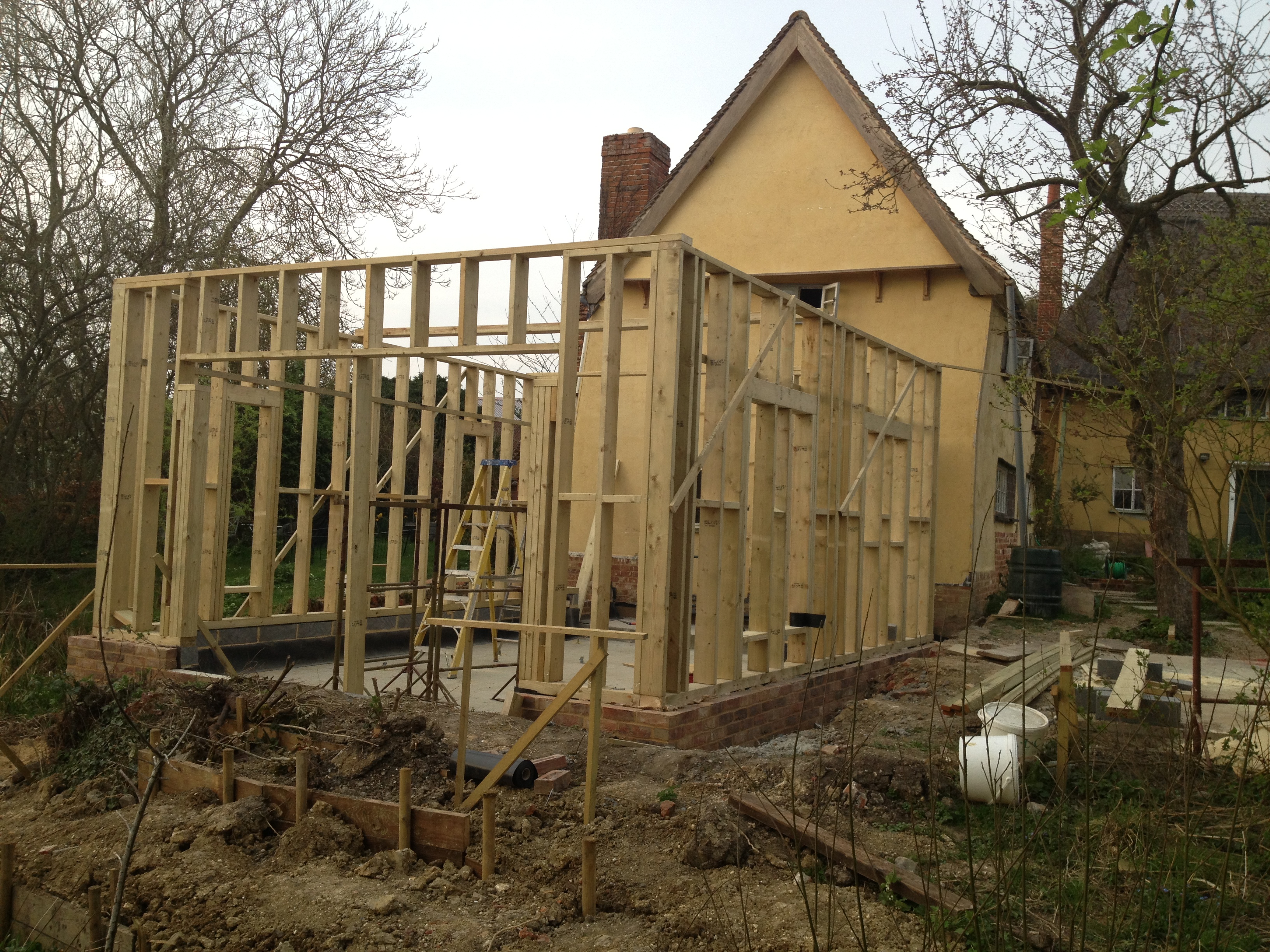
The timber frame takes shapeThe roof timbers are added, with a Glulam beamThe panels are infilled with insulation, with plywood panelling behind
The extension is a conventional modern timber-frame building. First, a wood frame was constructed piece by piece by Terry Booty of Booty Builders and his team, Andrew and Tim, on a low brick base; then they filled the spaces between the timbers with blocks of Celotex insulation, today’s equivalent of the hazel sticks and clay daub that fill in the panels of the old house.
After several redesigns, the engineers settled on a system of 12 piles and a reinforced slab. It was a bit of a saga getting to that point, because although we are next to a pond, there was nevertheless more water in the trial borehole than the experts expected.
Auger drilling an 11 metre test hole.
The initial plan by the contractors was to auger the piles, to avoid using a pile driver near an old building. However, this was vulnerable to water inflows, which proved excessive, which would have made it hard to be sure the concrete would set properly.
So we were advised to switch to steel-cased piles, with the first three metres augered. With hammered piling starting three metres below ground, it was hoped that the vibrations in the old house would be reduced. This proved the case, though we checked the house carefully every hour or so to make sure there was no damage. Continue reading “Foundations”
Early on, we filled panels where the clay had disappeared with new wattle and daub. This year we have switched to a new plan: these panels, which had been filled in the last 30 years with Thermalite blocks and broken bricks, have been made into a breathable hemp sandwich.
We lined the outside of the building with Savalit woodwool boards (as described before), then plastered them with haired chalk and lime mix bought from Anglia Lime. We used battens to fix Savalit boards on the inside, recessed just enough to take the plaster, and gave them a thinner layer of chalk and lime plaster, also with hair. In fact, internally, Savalit boards can take an extremely thin, almost skim coat of haired lime plaster and still look good.
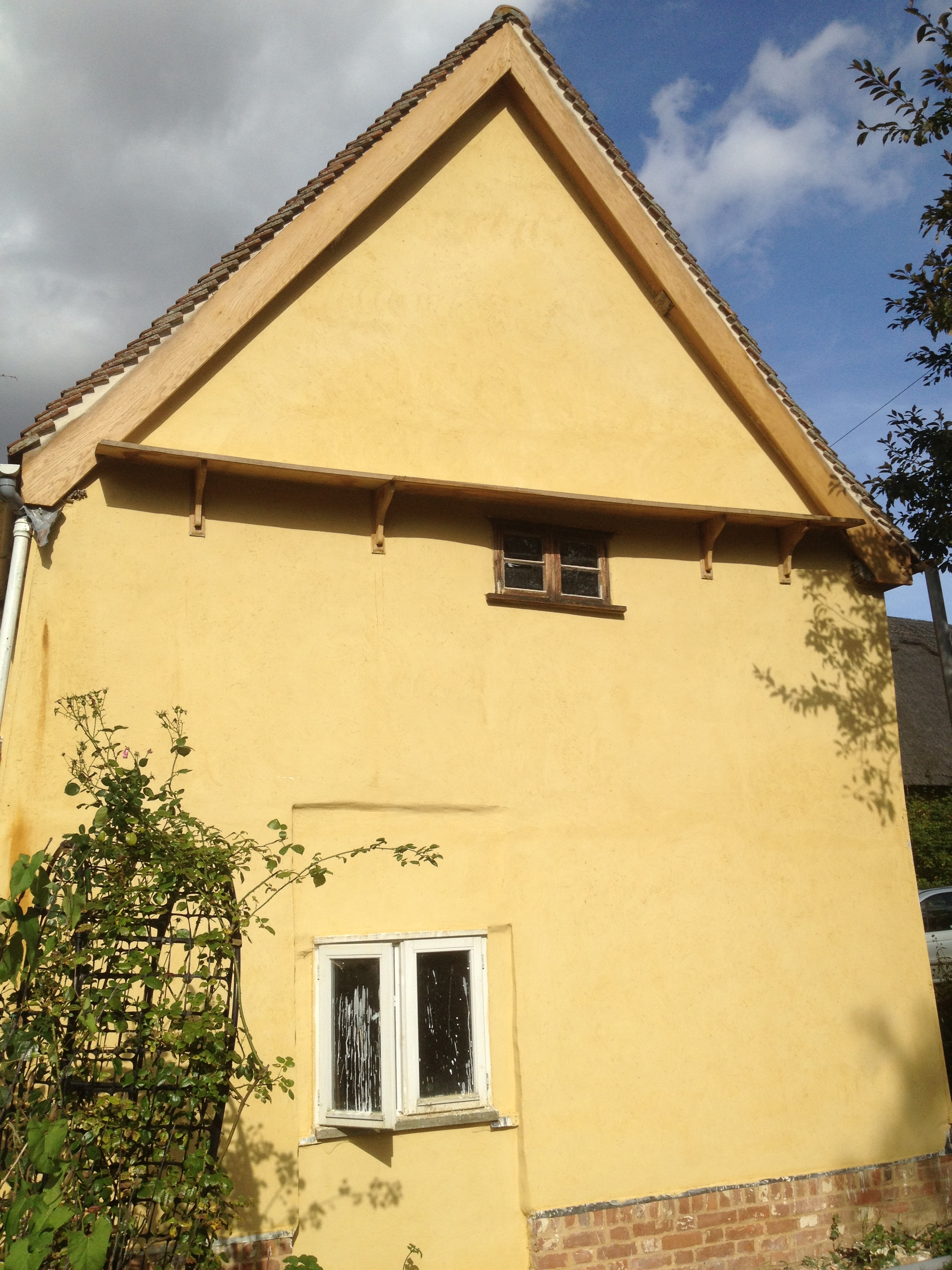
All new plaster, limewash, oak pentice board, soffits and bargeboards.
When the cement was removed, we found some repairs were needed for the timber frame, including a new stud where an old one had disappeared (judging by the empty mortice), completing another stud that had rotted away for the first foot above its mortice in the sole plate, a knee to reinforce the joint between a main internal beam and a post, and a strengthening of one of the corners, where a sound main corner post did not seem very well tied in to the sole plate. It was reinforced with a flexible glass fibre rod through the timbers and a steel plate. All the timber work was carried out by William Clement Smith. Continue reading “Oak and other problems under the old render”





 saving The Old Brewhouse