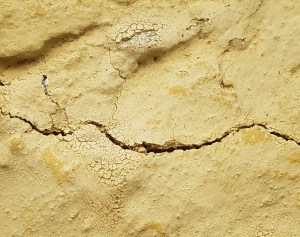
Plastering over the cracks

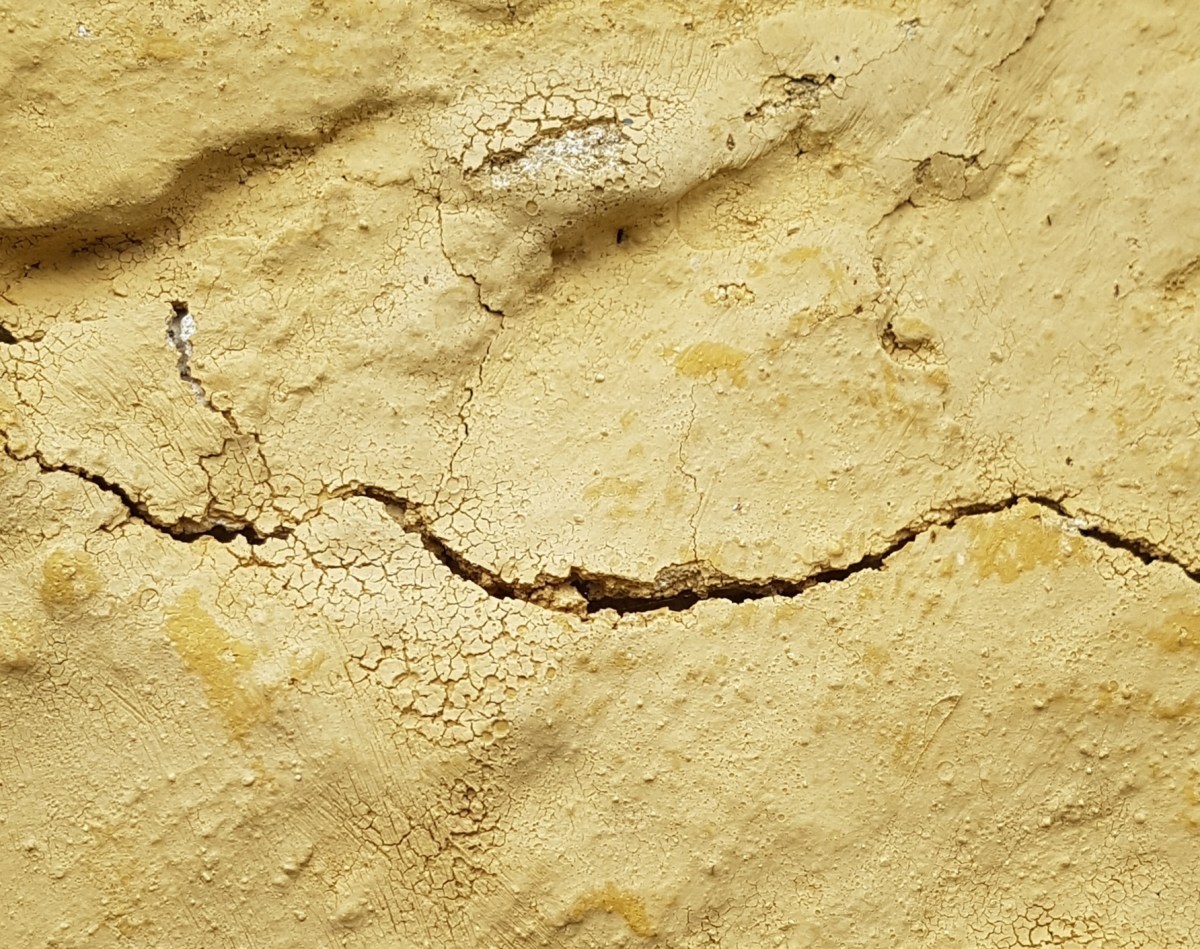
With the housepecker feeding on the building (see previous post), we were reminded to check the walls for surface cracks and any exposed clay daub beneath. The birds love digging into a soft clay surface to find insects.

Chalk-lime plaster from Anglia Lime is excellent for these quick repairs. It works almost like putting stitches or sticky tape over a crack. When cured, the fibres give a thin layer of plaster a lot of strength. You can see this by picking up a dried spill: it will bend like a piece of leather and be resistant to tearing.

When the plaster is dry, it will be touched up with limewash

This is very helpful on an old clay daub wall, which is always prone to non-structural surface cracking, as the clay underneath the wall’s footings dries in summer and wets in winter. These surface  cracks are not serious, but if left can quickly spread, letting water, insects and eventually woodpeckers get at the soft clay underneath.

Our walls are a messy mixture of surfaces accumulated over centuries.  We agreed early on with the conservation officer that we’d patch repair as much as possible to preserve the old clay, a piecemeal approach which is probably what the farmers have always done. A full surface strip and replastering loses a lot of old material.

The clay daub seems to have been preserved originally with many layers of limewash straight onto the daub, creating a thick crust like a plaster, which is still there in some places. In more recent years – which could mean back into the 19th century –  thin patches of cement have been slapped on to cover damaged clay surfaces, sometimes with broken brick shoved underneath to fill holes in the clay daub. 

When we arrived, the first thing we did to the outside was to use new clay daub and a lime and sand render on a dozen areas where old coatings had fallen off, the clay was exposed and woodpeckers had dug deep holes (I’m afraid I do go on about them sometimes, lovely as they are). After some good expert advice, we later switched to a chalk-lime plaster instead of a render, which is much better.

The stitch repairs are not meant to be permanent, and eventually more substantial work will be needed. In fact, we expected these quick and simple repairs to last a few months to give a breathing space while we found time to do the bigger jobs. But in the 5 or 6 years since we started routinely catching cracks in the surface early and plastering over them with the chalk-lime mix, we haven’t had a single large surface failure. In the previous couple of years, several quite large chunks of old render had fallen off.

It sounds like a bodge, and it is, but it’s in the spirit of patching, make do and mend that has kept the walls together for so long.

Of course, when there is a serious deterioration of the wall, for example when some old cement render drops off and pulls clay with it, then there is no alternative to a full repair. We will use new clay daub to fill cavities and then plaster to protect the surface.

Thin layers of ready-mixed chalk lime from Anglia Lime were plastered over the cracking and a few inches either side. You can use a trowel or – if you don’t mind mess – apply and smooth the plaster with your fingers, wearing PVC gauntlets. That works better than it sounds, because it pushes the plaster into the cracks. PVC gloves are also good for smoothing. In either case, a large bucket of water is needed nearby for regular rinsing of tools and gloves.

Our method works, but the result is not pretty – I remember the appalled expression on the face of a professional plasterer when he saw our walls!

Housepecker break in

We kept hearing the ‘tap, tap, tap’ of a woodpecker on the end gables of the house. By the time we walked round to look, all we heard each time was a rush of wings and a distant woodpecker disappearing over the other end of the garden.

It was so fast and blurred it was hard to tell whether it was the green or the greater-spotted woodpecker. Both are seen regularly in our garden, and we think we’ve also had lesser spotted around. The green woodpecker usually feeds on the ground, rather than clingjng to walls.

The evidence of what the bird was up to was visible in marks on the barge boards and soffits, where the woodpecker must have detected rotten wood and boring insects.

When I get my camera out fast enough one day, I’ll replace this stock photo with one of our visitor.

Today when I arrived round at the wall, the bird was still there, undisturbed by my approach, but I could not see it. The noise continued louder than ever, as if it were amplified.

And so it was: the woodpecker had broken through into the loft, found more old wood to attack, and the noise was amplified in the loft space like a sounding board. Because it was now inside the house, the bird had not sensed me coming.

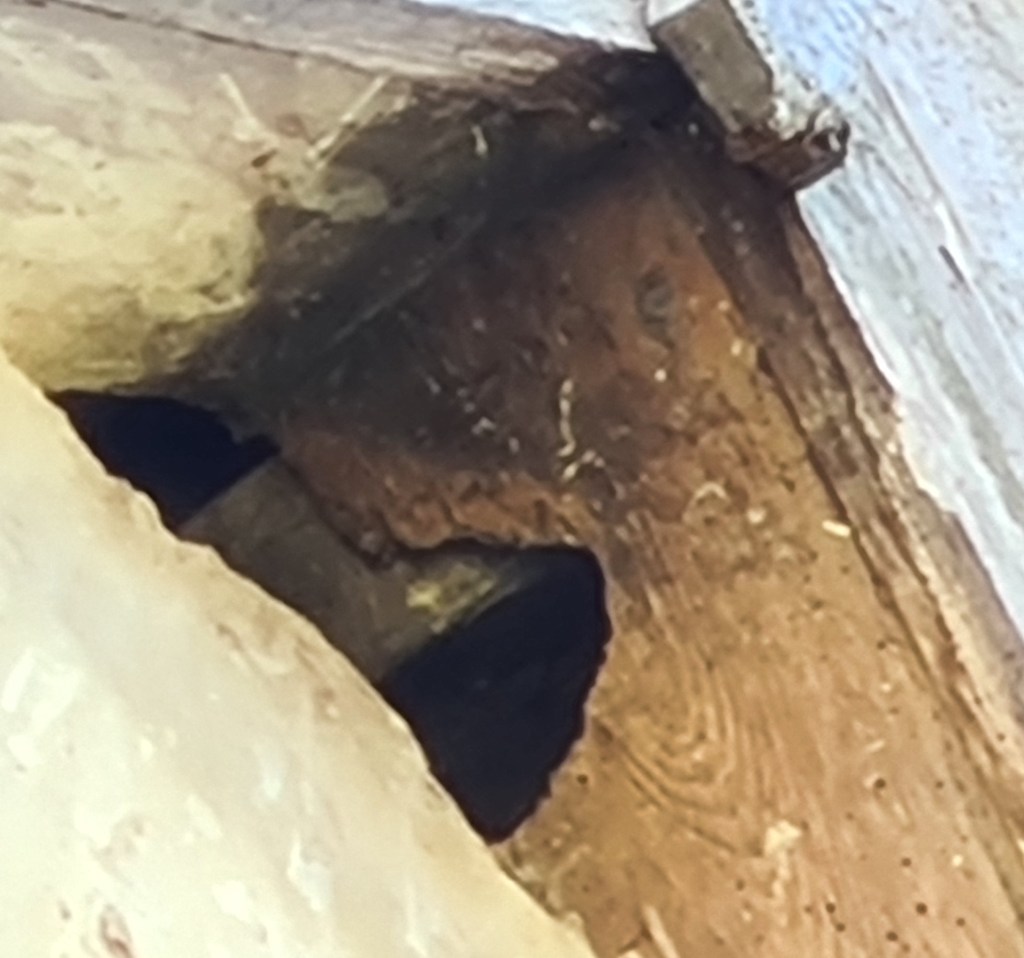
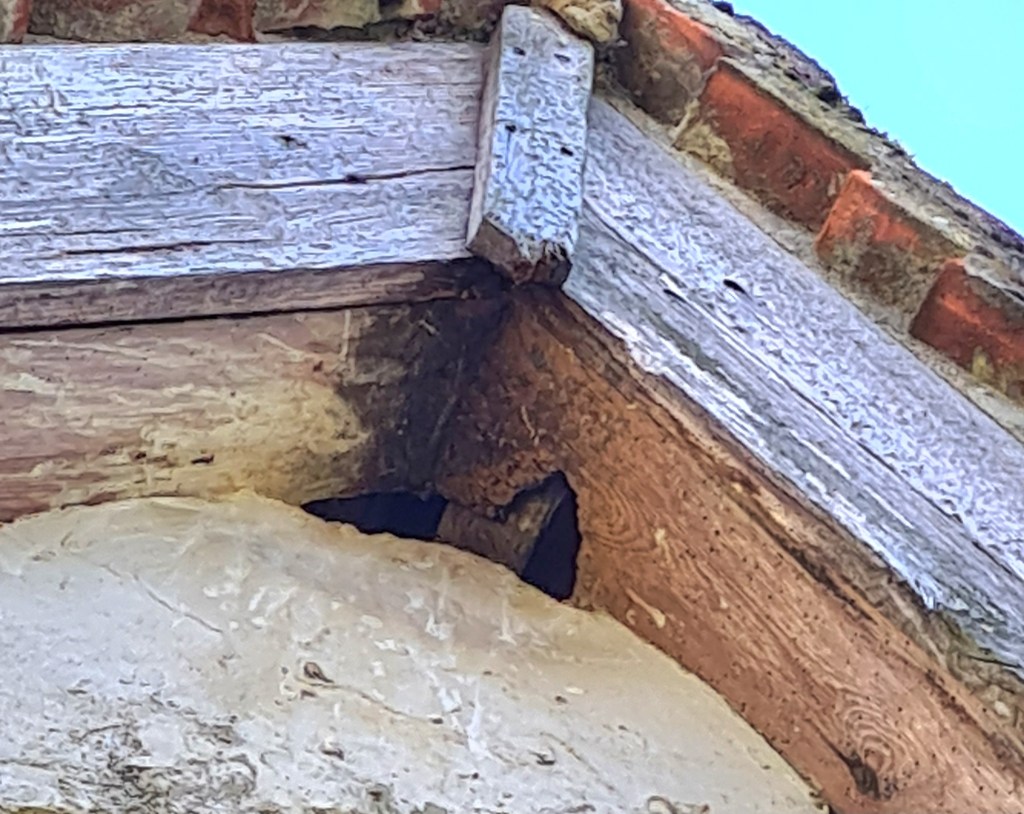
I watched and listened for a couple of minutes before a (greater, I think) spotted woodpecker emerged rapidly and whirred off. The hole it made is in a soffit, where the two barge boards,and the soffits underneath them, meet at the peak of the gable.

Woodpecker hole in the soffit

There was a tiny hole there before through which only bats could pass. We know that because we once found a dead pipistrelle that had fallen through a crack in a bedroom ceiling (now filled). But the hole is now far bigger, easily enough for squirrels to get inside and rampage round the contents of the loft.

Right at the peak of the gable

What the woodpecker is so keen on inside we don’t yet know, but with plenty of old wood there is no doubt a large population of insects to feast on.We are going to have to stop it.

Previous woodpecker attacks have always been on our old walls, which they dig into searching for insects wherever the clay daub is exposed. We have to do regular repairs to the surface stop those attacks, because woodpeckers are only interested in soft places where plaster and limewash coatings have dropped off.

A proper repair to the soffit will need scaffolding, which will be a lot of money. That whole gable is anyway due for repairs in a few years, and it would be better to do both jobs at the same time to avoid paying twice for scaffolding.

We’ll instead empty that end of the loft of long term storage so we can get to the gable, and block up the hole from inside, possibly by nailing some spare lead sheet over it. That means carrying some old boarding to the loft to lay as I move along, because there’s no floor near that gable end.

I’m not looking forward to it – the job is about as enticing as unblocking a sink, my other pet hate, so it will not be at the top of my priority list. But it must be done.

A freezing draft and a hidden window

We are still finding out new things about the Old Brewhouse, most recently from a blast of freezing air that suddenly started coming out with unusual ferocity from the gaps round a fireplace cupboard door. Inside the cupboard, bits of plaster had fallen and a gap above the inside of the door had got bigger.

I anxiously thought – wind damage: what’s blown loose? But closer inspection showed that the wind was blowing down a narrow gap between the structure of the big brick fireplace, with its bread oven and chimney, and the clay daub wall of the house.

The solution – plywood over the gap, sealed round the edges with hemp insulation tapped in with a screwdrivercaulking without the tar
Continue reading “A freezing draft and a hidden window”

Cracks

The hot, dry weather has produced many more cracks than usual in our front wall.

20180816_115731.jpg

Much of it is plain clay daub with thick layers of limewash and here and there a smear of recent cement where previous owners had tried to stop the clay falling out. There is no evidence of it ever having been rendered or plastered on laths. Continue reading “Cracks”

More repairs – 2010

  • Chris and I filled the very large number of holes left in the kitchen and living room by the replacement of the sole plates, including some complete damaged panels. Wherever possible, we used hazel lattices and clay daub for the repairs, with a skim of lime render inside, finished with limewash. We salvaged old clay and plaster. See ‘wattle and daub’ and ‘wattle and daub inside’ posts.
  • The interior ground floor woodwork was painted and the brickwork limewashed.
  • An electric storage heater Aga was installed in the kitchen.
  • We deliberately spurned a fitted kitchem. The idea is that separate pieces of kitchen furniture unattached to the walls allow the walls to breathe and stay dry – important given our repair philosophy of using the natural characteristics of the materials to keep the building dry through encouraging breathability.
  • We paid two local landscapers to lay hardcore and a stepping stone path from the entrance to the front door, and to make a small brick patio outside the front door, linked to the doorstep by limestone slabs on a brick plinth. They also made a low brick wall to hold back the slightly higher level area outside the kitchen window, which we gravelled. They erected a garden shed we had bought.
  • A fencing contractor installed a full size five bar farm gate. We later replanted the damaged hedge either side of the gate with hawthorn and field maple.

Continue reading “More repairs – 2010”