
What wood is the floor made from and how old is it?
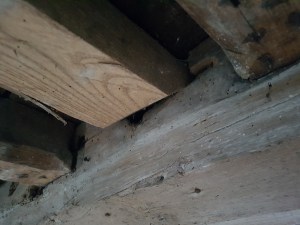
Clue (1): an extra pair of joists made of ash, not the usual oak, have been inserted crudely either side of the central beam, with notches and wedges instead of a mortice and tenon.
What wood is the floor made from and how old is it?
Clue (1): an extra pair of joists made of ash, not the usual oak, have been inserted crudely either side of the central beam, with notches and wedges instead of a mortice and tenon.
I go into a great deal of detail in these floor posts, on the grounds that if you’re interested in repairing a very old floor you’ll need it; for the rest, read no further! Over the years it’s the blog posts like this that seem to be read most, I assume by people doing similar jobs.
Rotten sections, weakened sections, blackened, stained and crack and holed sections – the whole messy old floor came together into one attractive, if battered, whole, once beeswax polish was applied.
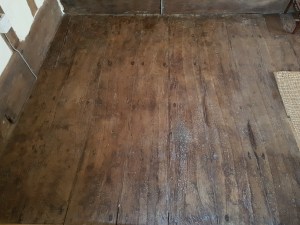
It’s great what a coat of beeswax can do for a damaged floor.
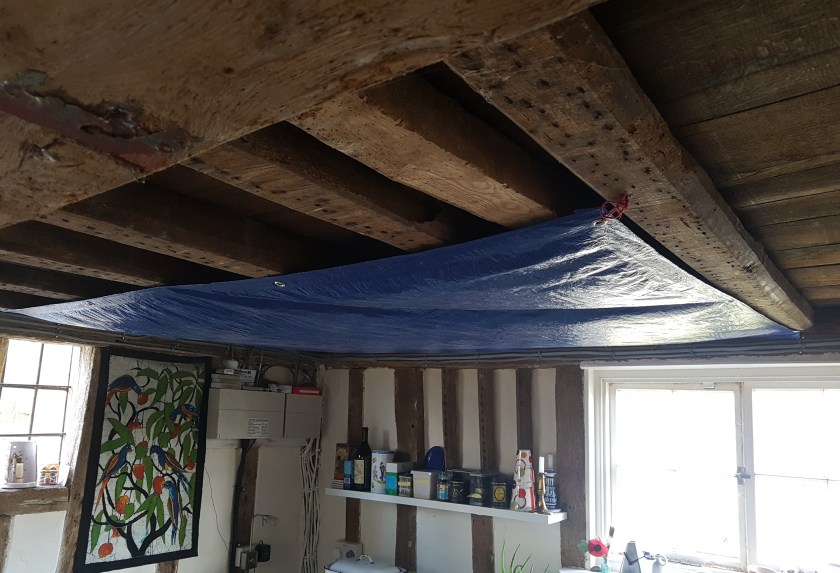
The first thing to do was to protect the room underneath from debris falling through the many cracks as we worked on the floor above. The solution was a plastic tarpaulin tied to the joists:
The second thing to do was to make sure the boards were firmly on their joists so not springy when walked on. There were two bad patches, where the boards had to be screwed down hard onto the joists to stop movement. Since the undersides were exposed, we were also able to push in wood spacers from below. Continue reading “Repairing the floor – 2”
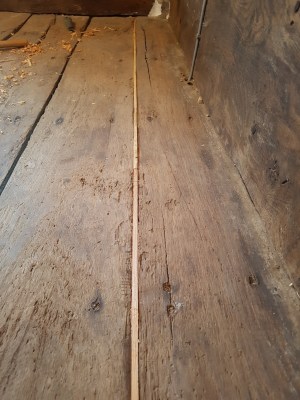
The floor we want to repair is of unknown age but must be pretty old, not just because of its battered state but because the boards are of uneven widths of up to a foot or so, presumably because they were cut from the same tree. Continue reading “Repairing the floor – 1”
We’ve switched today from an old WordPress design to a new one that’s clearer and easier to edit. We also have a new site name, https://oldsuffolkhouse.com.
Our previous address https://oldbrewhouseproject.wordpress.com still finds us, and existing followers will continue to receive alerts without taking any action.
And now for the next challenge, but I need to get fit first: does everyone get quite as stiff as I do when trying to work for long hours on a floor? It is the most uncomfortable position to work in, apart perhaps from plastering a ceiling, but we are about to start on repairing a lovely old floor that until now has been covered to protect it, so the pain will be worthwhile (I hope). Not entirely sure what it is, but think that it is oak or elm. More later, as we get going on the job next week.
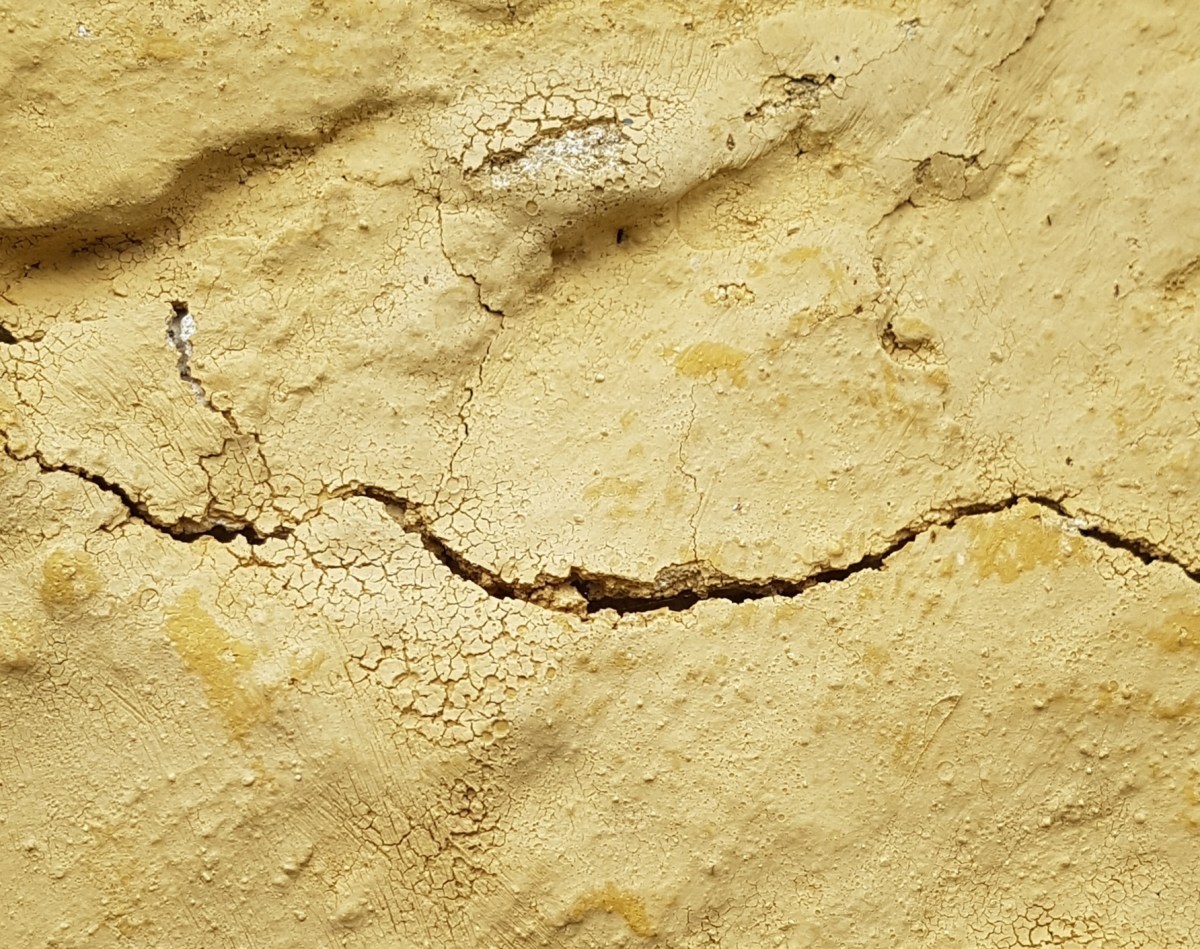
The hot, dry weather has produced many more cracks than usual in our front wall.
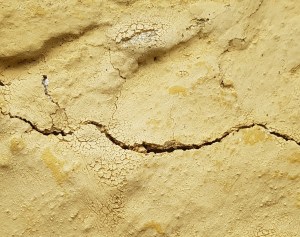
Much of it is plain clay daub with thick layers of limewash and here and there a smear of recent cement where previous owners had tried to stop the clay falling out. There is no evidence of it ever having been rendered or plastered on laths. Continue reading “Cracks”

According to one Suffolk expert, limewash was not used inside homes. If true, then we’ve been doing it wrongly for years. Instead distemper made from chalk and milk casein is said to have been the covering of choice, so this winter we’ve tried it. Continue reading “Distemper”
Preparing a room for decorating today, I was filling holes in the lime plaster in a first floor room when I heard a loud knocking on the other side of the wall. I knocked back hard with a trowel handle on the wall but it didn’t stop so I dashed outside to shout at the woodpecker – yet again, they’ve found a way into the clay and they are digging holes for insects, this time too high for anything but scaffolding for repairs.

It had gone before I got outside so I am not sure which variety it was – we’ve been attacked by green, greater spotted and lesser spotted (illustrated: one day I’ll be fast enough to get my own photo of a housepecker in the act!) Continue reading “Lesser spotted housepeckers”
I recently came across an 1874 description of a brewhouse which could almost be about ours. It is by Richard Jefferies*, a Victorian novelist and writer about nature and the countyside. The brewhouse he describes is part of a multi-function farm service building that is also used as a dairy, for cheesemaking and for servants’ accommodation. Evidence we and the previous owners found in the building fits that pattern rather closely. Continue reading “Brewhouses, dairies and servants’ quarters”
It is now 10 years since we bought this house. I’ve just realised, looking at the blog, that there’s been nothing to report since February.
What a pleasure: there have been 10 years of projects, major and minor, and always a substantial job or two waiting to be done, and this is the first year without one. It is wonderfully pleasant to focus on gardening, or to sit in a comfortable chair to keep a lookout for that swimming grassnake, or be delighted by a dragon or damsel fly, or by a kingfisher or flycatcher. The hours spin by. Continue reading “Take time to sit back and enjoy”
I’ve been wondering how best to redecorate a room whose surfaces are finished in old materials – clay and plaster – but which have been painted with modern emulsion. That may be creating a breathability problem.
Very modern emulsions are impermeable to moisture. Cruder basic emulsions have a certain amount of breathability, but it’s hard to tell which it is, looking at the result at least 30 years after it was last painted. So should the emulsion be removed? Continue reading “Limewash over emulsion paint “
Just discovered a disadvantage of shallow brick footings: a large rat managed to tunnel right under them and up inside where the water and waste pipes enter and leave the building.
Caught the rat with an electronic trap and filled the hole down to the bottom of the footings with a couple of buckets of limecrete, using lime, sand and gravel.
Had to do it twice more because another rat twice bypassed the limecrete by digging a longer tunnel, partially removing the still soft limecrete as it went. Continue reading “Rat assault “
It has been a positive pleasure painting the windows in the last few days using custom-mixed linseed oil paint from Ingilby’s of Glemsford. The window frames were stripped and repaired, and much of the putty renewed, some time ago, and they have since been given several coats of pure linseed oil to prepare and waterproof them. But for various reasons, I didn’t get round to completing the job.
Now I’m painting, I can immediately see the benefits of using linseed oil on old wood. Where I’ve left a leading edge of paint on bare wood, the oil spreads out of the paint into the wood, which seems to lap it up, almost pickling the timber in oil. That can only be good for long term preservation, especially as absorption is helped by the slowness with which the paint dries. Continue reading “Old fashioned paint”
The first step is to prepare some of our grey boulder clay, which we saved from the excavations for the extension. It is much better than the brown clay we used previously when we bought ready mixed daub from a farm in Essex.
We pounded the clay lumps with the end of a piece of timber until they became like smooth plasticine. Continue reading “Repairing the damage “
 saving The Old Brewhouse