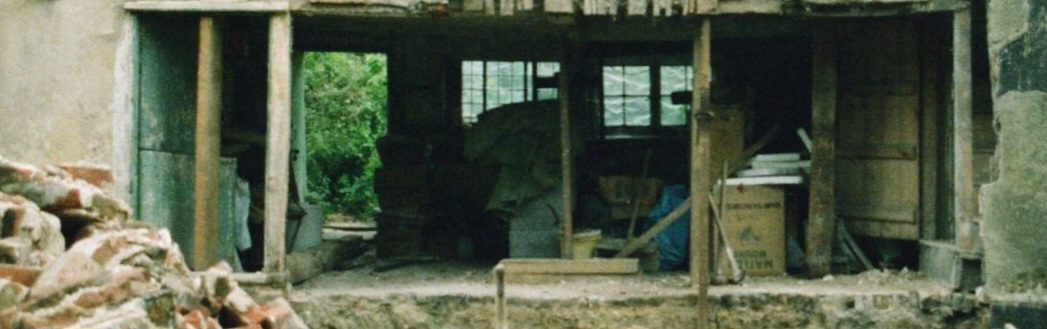
The photos below are among some recently found by our next door neighbour, Ginny, showing work carried out by her late husband, Paul, before we bought the Old Brewhouse. His repairs and alterations were even more extensive than we realised when he first described them to us. These photos add new insights to the history of the building.
(Top) The front of the house before the plaster over two mediaeval mullion windows was removed. (Above) Rebuilding the chimney at the back, demolished because it was on the point of collapse
For more photos and descriptions of previous work on the building, follow this link.
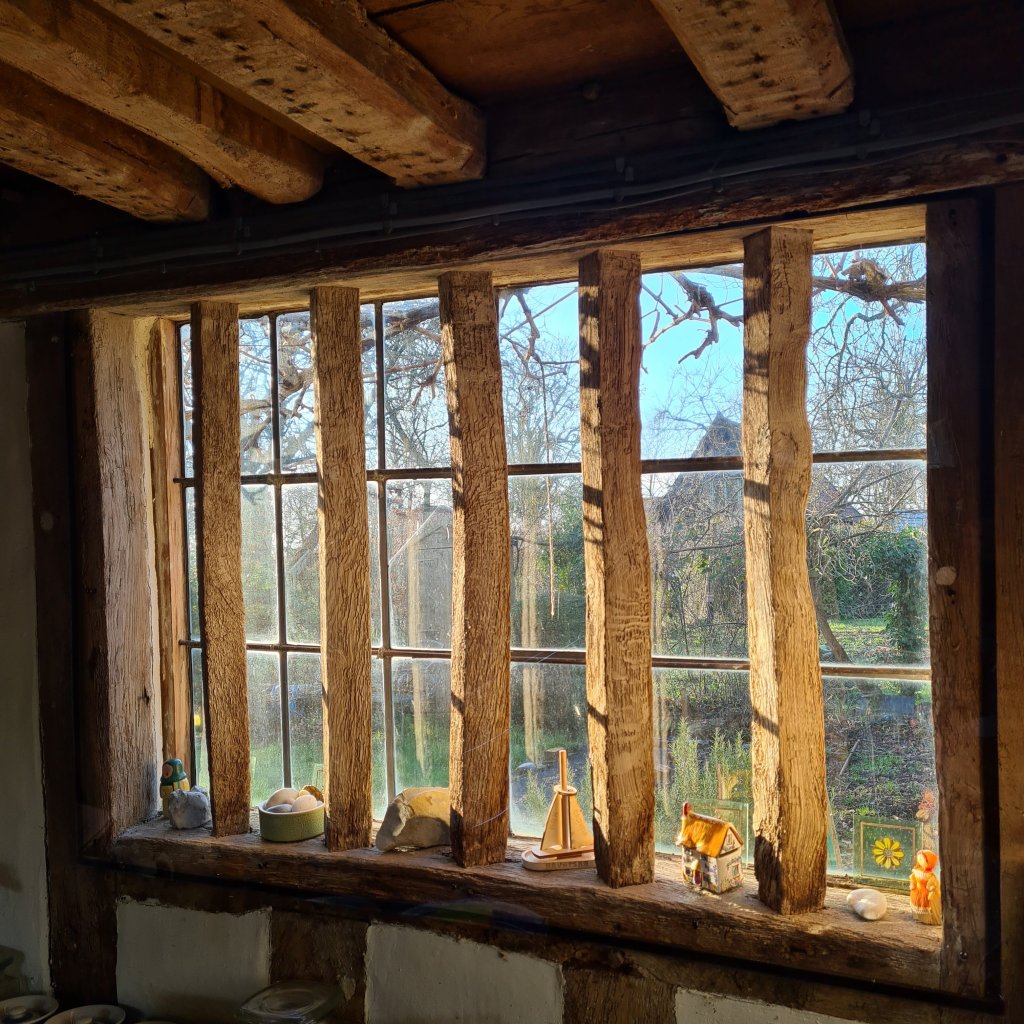
We’ve been worrying more about fire safety since we put secondary glazing on most of the old windows a year ago. All but one of our mullion windows are impossible to get through because the ancient oak bars are as strong as steel. The secondary glazing (or rather polycarbonate sheeting) makes them even more impenetrable.
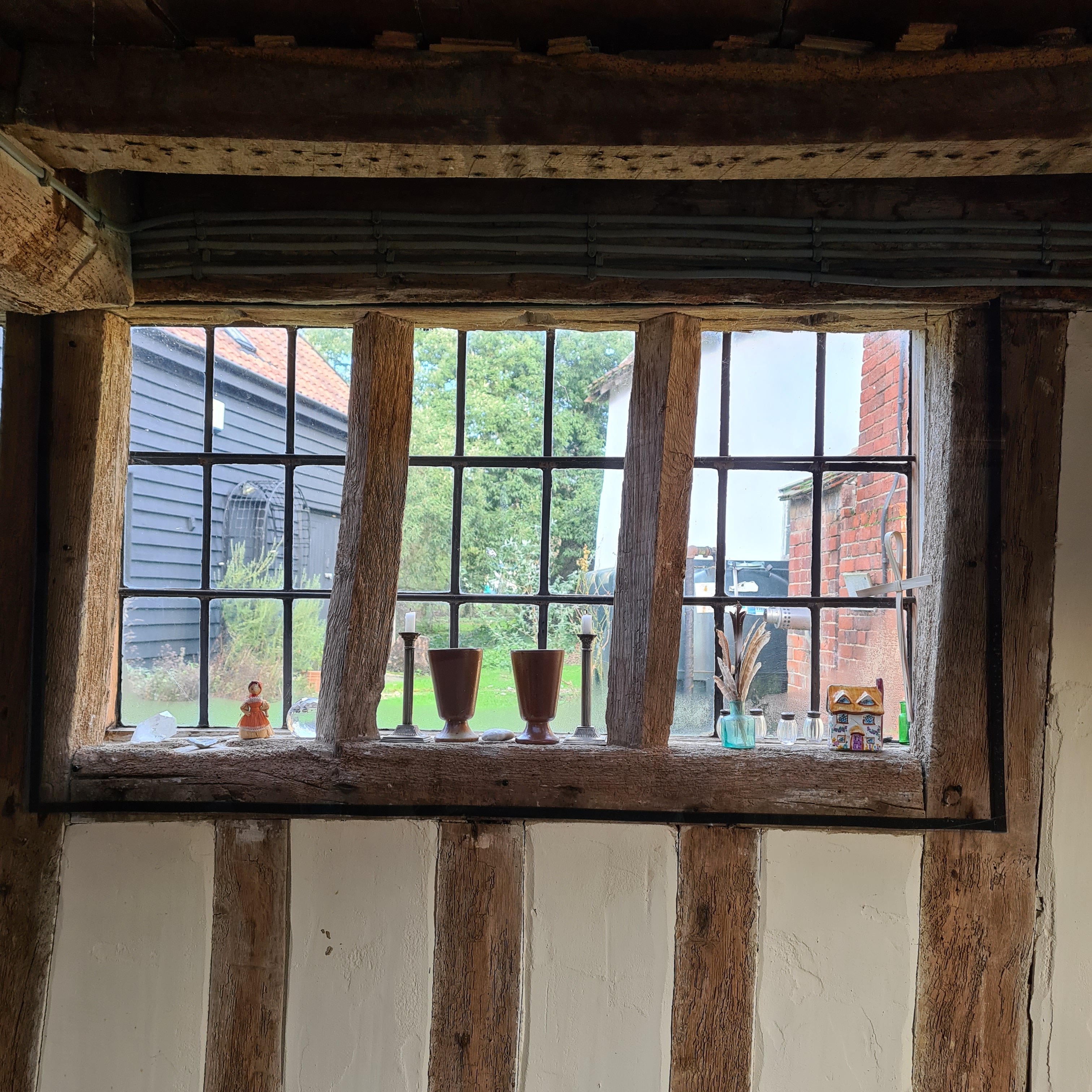
Downstairs has no no internal doors, five external doors and two opening casement windows, so reassuring if any of the multiple smoke alarms go off. Upstairs, in the bigger of the old bedrooms, one big window has had enough mullions removed to make it easy to get through as an escape route.
The other 16th century bedroom has three tiny double casement windows. But only one casement on each of the three can be opened – the other side is fixed. A child could squeeze through but an adult would find it a challenge in an emergency.
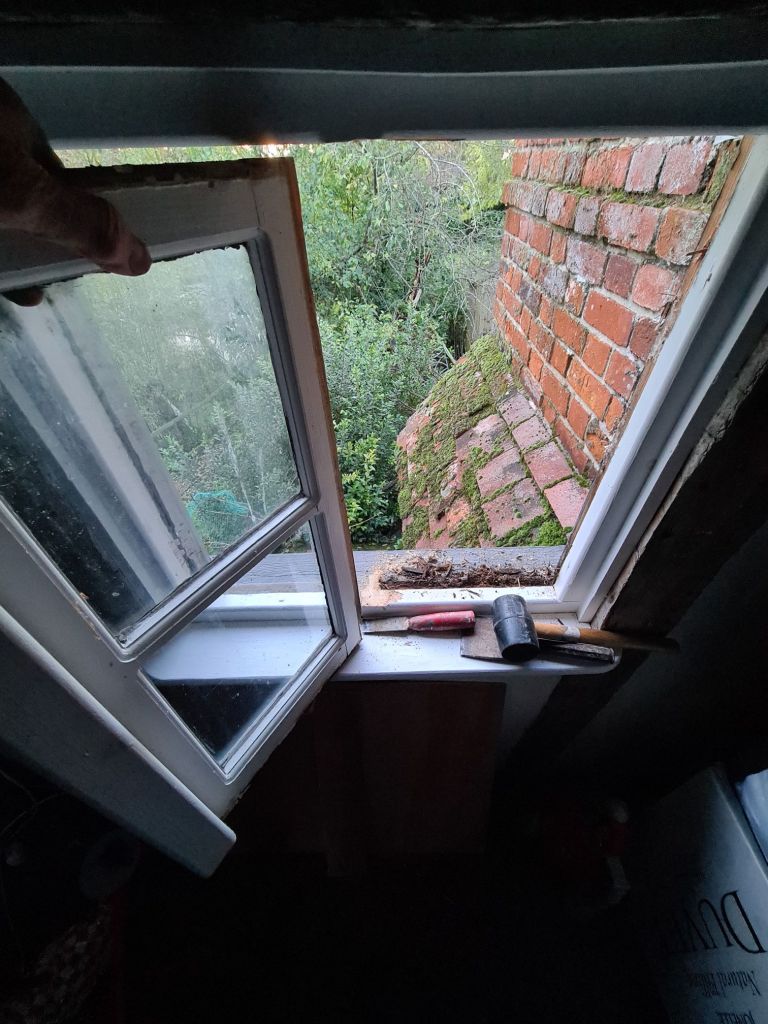
The simplest solution is to make both sides of a window open. We chose the bigger of the three, which is also the one at the back with an easy drop, to try this out.
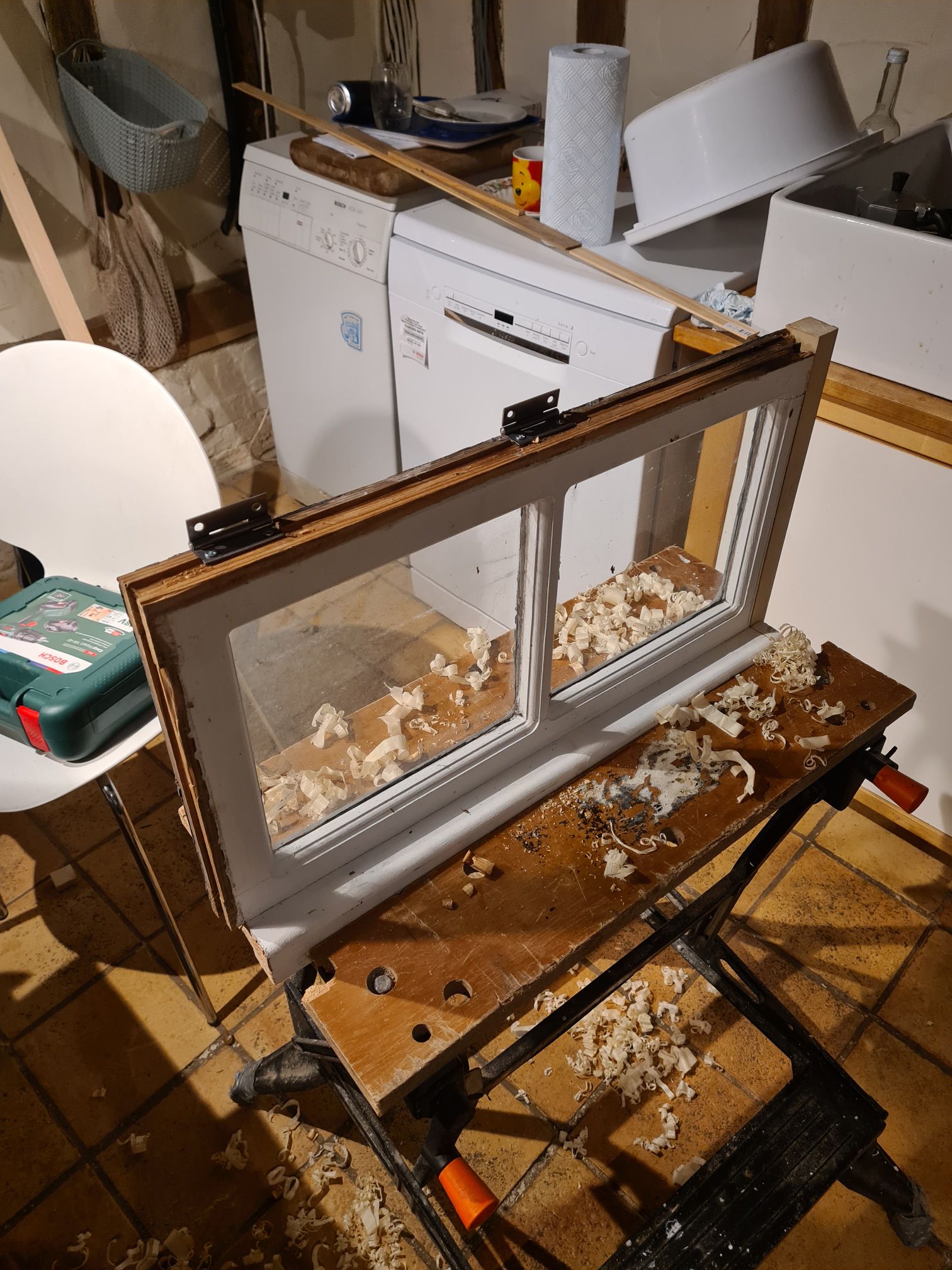
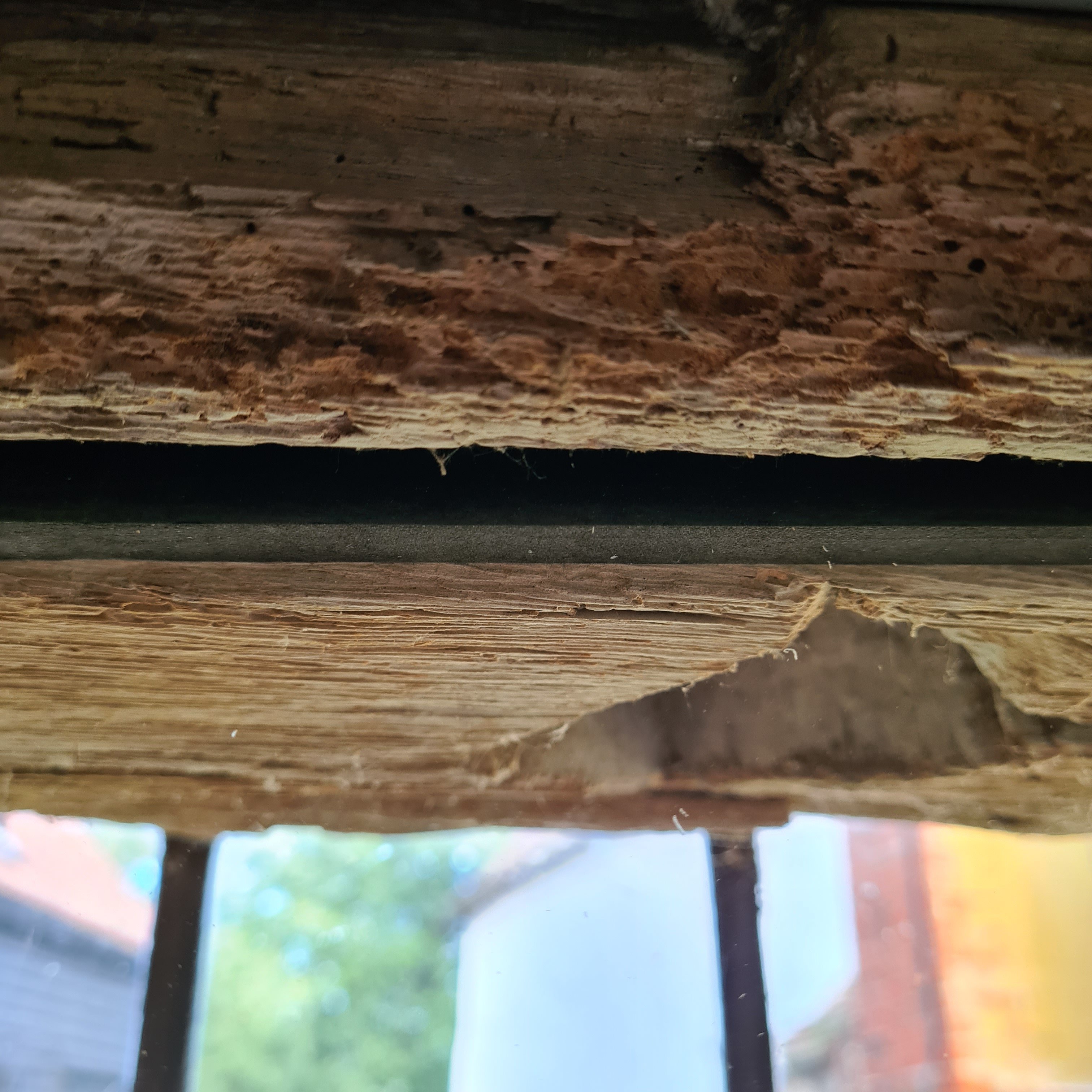
The central post (not sure if that’s the joiner’s term for it) was cut through top and bottom. The fixed side of the window was prised away from the frame, trimmed, and hinges were fitted, while still attached to the post.
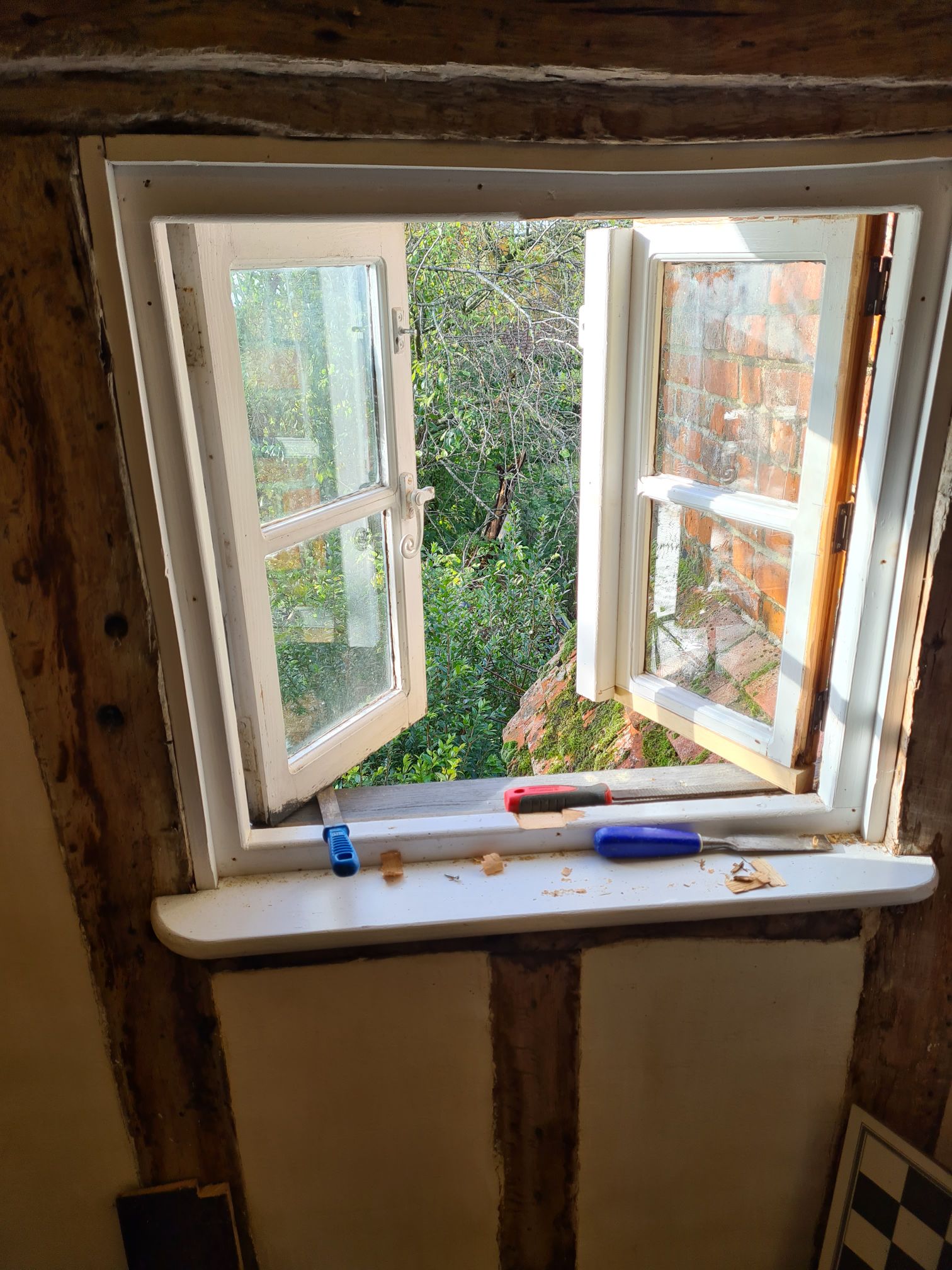
It was then refitted to the window frame, with a new security latch and two bolts. So we now have a window even a large adult could get through easily. I have to admit, we should have done it years ago.
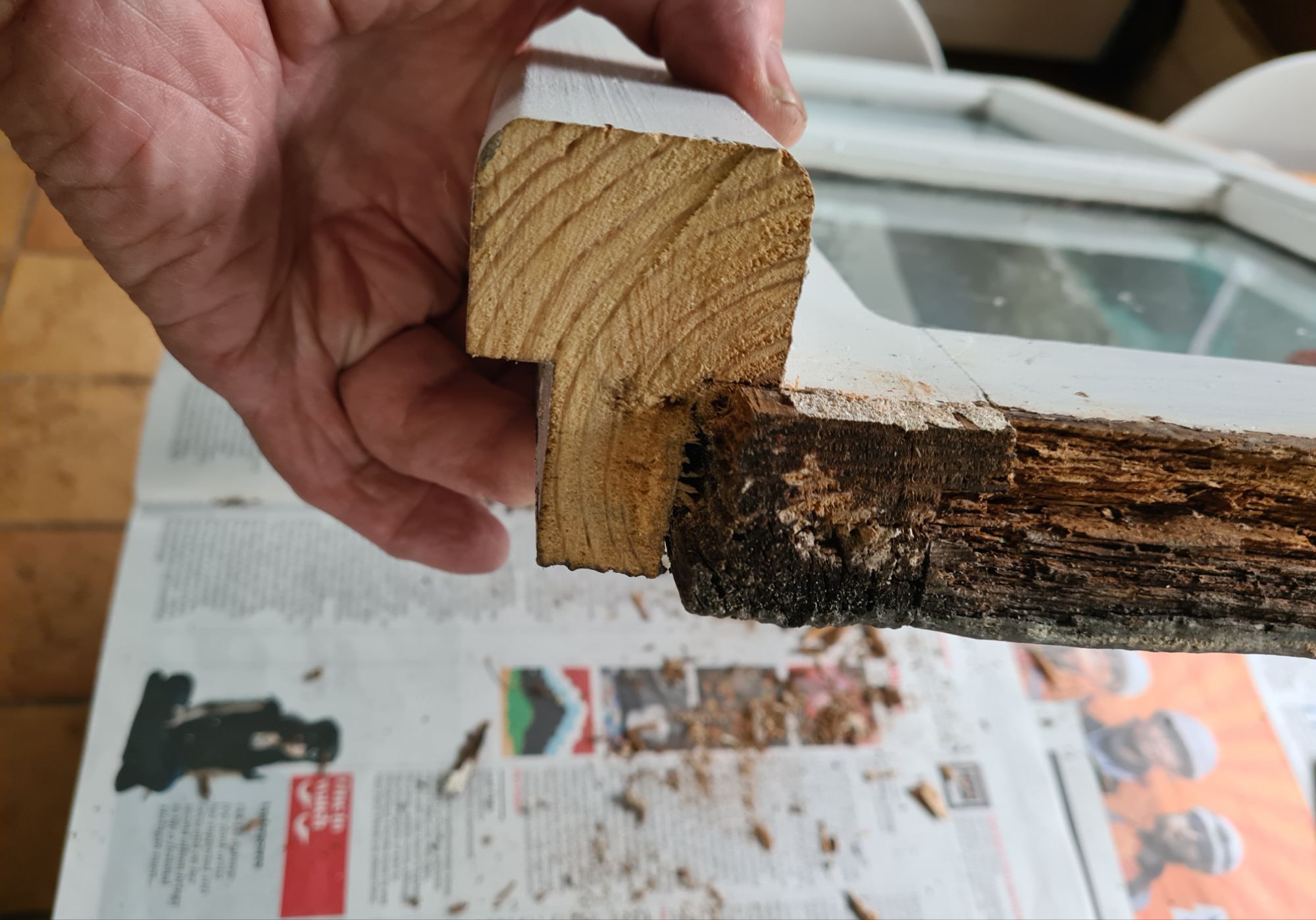
Taking out the old window, which luckily was lightly nailed. We feared it might break and have to be completely remade, but it was intact.The saw cut and thebottom of the window, which was rotten. The rot was cut out and a new piece glued in.The window was a tight fit and had to be shaved to fit back with hinges The refitted opening window. The weather was breaking so finishing work– painting and a final trim – have been left for a dry spring day.
With the housepecker feeding on the building (see previous post), we were reminded to check the walls for surface cracks and any exposed clay daub beneath. The birds love digging into a soft clay surface to find insects.
Chalk-lime plaster from Anglia Lime is excellent for these quick repairs. It works almost like putting stitches or sticky tape over a crack. When cured, the fibres give a thin layer of plaster a lot of strength. You can see this by picking up a dried spill: it will bend like a piece of leather and be resistant to tearing.
When the plaster is dry, it will be touched up with limewash
This is very helpful on an old clay daub wall, which is always prone to non-structural surface cracking, as the clay underneath the wall’s footings dries in summer and wets in winter. These surface cracks are not serious, but if left can quickly spread, letting water, insects and eventually woodpeckers get at the soft clay underneath.
Our walls are a messy mixture of surfaces accumulated over centuries. We agreed early on with the conservation officer that we’d patch repair as much as possible to preserve the old clay, a piecemeal approach which is probably what the farmers have always done. A full surface strip and replastering loses a lot of old material.
The clay daub seems to have been preserved originally with many layers of limewash straight onto the daub, creating a thick crust like a plaster, which is still there in some places. In more recent years – which could mean back into the 19th century – thin patches of cement have been slapped on to cover damaged clay surfaces, sometimes with broken brick shoved underneath to fill holes in the clay daub.
When we arrived, the first thing we did to the outside was to use new clay daub and a lime and sand render on a dozen areas where old coatings had fallen off, the clay was exposed and woodpeckers had dug deep holes (I’m afraid I do go on about them sometimes, lovely as they are). After some good expert advice, we later switched to a chalk-lime plaster instead of a render, which is much better.
The stitch repairs are not meant to be permanent, and eventually more substantial work will be needed. In fact, we expected these quick and simple repairs to last a few months to give a breathing space while we found time to do the bigger jobs. But in the 5 or 6 years since we started routinely catching cracks in the surface early and plastering over them with the chalk-lime mix, we haven’t had a single large surface failure. In the previous couple of years, several quite large chunks of old render had fallen off.
It sounds like a bodge, and it is, but it’s in the spirit of patching, make do and mend that has kept the walls together for so long.
Of course, when there is a serious deterioration of the wall, for example when some old cement render drops off and pulls clay with it, then there is no alternative to a full repair. We will use new clay daub to fill cavities and then plaster to protect the surface.
Thin layers of ready-mixed chalk lime from Anglia Lime were plastered over the cracking and a few inches either side. You can use a trowel or – if you don’t mind mess – apply and smooth the plaster with your fingers, wearing PVC gauntlets. That works better than it sounds, because it pushes the plaster into the cracks. PVC gloves are also good for smoothing. In either case, a large bucket of water is needed nearby for regular rinsing of tools and gloves.
Our method works, but the result is not pretty – I remember the appalled expression on the face of a professional plasterer when he saw our walls!
George Monbiot, an influential writer on enviroment and climate, made a grovelling apology in the Guardian not long ago. It wasn’t for any mistake in the paper, but for having personally owned three wood-burning stoves for the last 14 years, which he’d decided was a terrible error. Not only do they produce large amounts of carbon dioxide, they also spew out dangerously polluting particles.
So while I’ve been chopping wood for the winter, I’ve been worrying about our woodburning stove, which we installed in 2009. Are we poisoning ourselves and others, and damaging the planet into the bargain?
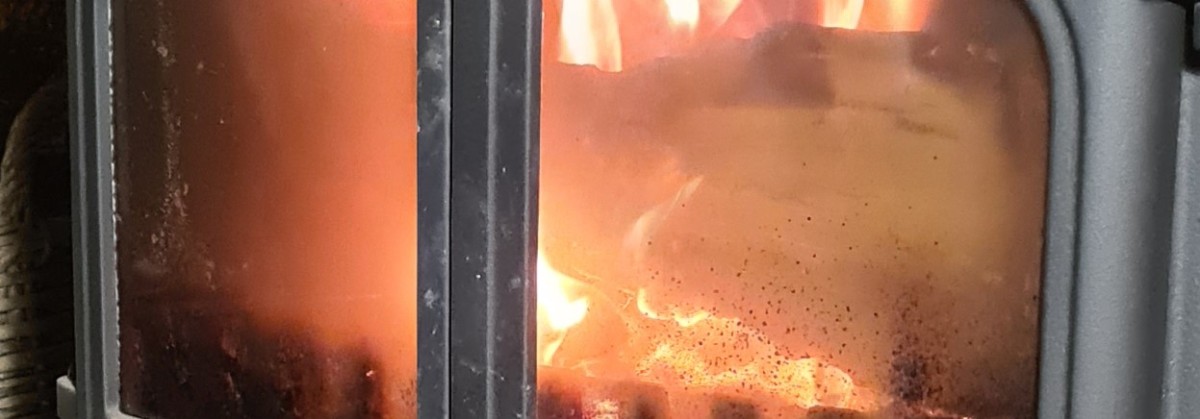
Our Morso wood burning stove
Now you could say that with 3 stoves for 14 years Monbiot has had 42 warm stove years against our modest 14 since 2009. He’s pulling up the ladder behind him, so we don’t need to feel bad about it. It will be another 28 years before we’ve done as much damage as him.
You could also look back 15 to 20 years and find a lot of climate conscious people promoting the idea that wood is a good source of heat because it is renewable. Those who have had wood burners for a long time installed them in good faith, and are entitled to feel a bit aggrieved when the advice reverses (just like the advice to buy diesel cars for the sake of the planet, which was also suddenly reversed).
Enthusiasm for wood burning led to some serious mistakes, both in the installation of thousands of wood chip boilers in the home and also in government policy: converting the huge Drax coal power station to wood burning has turned out the opposite of a climate friendly policy.
Monbiot’s case against wood-burning stoves is that though they are owned by only 7 or 8 per cent of Britons they create more dangerous pollution than all the cars on the road, and carbon dioxide emissions from stoves are contributing to the climate crisis.
Much of the wood burned is said to come from unsustainable sources and sometimes from trees that are unnecessarily felled for profit. The time had come to own up after years of keeping his ownership quiet, Monbiot said, in what read as an overwhelming rush of guilt.
What are we going to do? Nothing. Here’s why:
The house is built from timber and clay and has never been heated by anything other than burning wood. We decided when we repaired it to stick with the original heating, replacing an open fire by putting the most powerful domestic wood burner we could find into the large brick fireplace. (At some earlier stage the building had also been a brewhouse with a central hearth).
This was a much better solution than the usual plan with houses off the gas grid, of installing an oil or gas tank outside and a full wet central heating system. That would dry out the whole building, in a way which we suspected could be potentially damaging.
We did not want to give up entirely on modern standards of heating so the compromise was to install individual electric radiators. Other than the wood burner we are entirely electric, but the wood burner allowed us to keep the electricity bills well down until the 2022 fuel crisis.
We have now decided to switch the emphasis more towards off-peak storage heaters to take advantage of the much increased differential between night and day rates. We have just added two really big ones. We also signed years ago with an electricity supplier that has most of its contracts with renewables – wind, solar and nuclear.
By avoiding direct burning of oil or gas and focusing on the combination of electricity and wood burning I think we’ve found a better solution than ditching our wood burner in guilty panic like Monbiot.
What about the health risks? We are in a small hamlet of a few houses surrounded by fields, so it’s not like a wood stove in town sending clouds of particles over nearby streets. There are miles of largely open country in which it can disperse.
And the risks to our health? We use dry hardwood, which produces very little smoke. It’s definitely not harvested unnecessairily – we have had a lot of dead and dying ash in the garden, and it is 11 years since we have had to buy firewood. We have planted more new trees than we have had to fell.
Good ventilation is an absolute necessity for wood burning and a closed stove produces far fewer pollutants than an open fire. Care has to be taken not to inhale fumes when lighting and refuelling but otherwise we are minimising the risks as much as we can. Also, the stove is usually lit only in the evenings in winter, and the heat in the fireplace bricks stores warmth that lasts well after the fire has gone out around midnight.
So put it this way: I don’t think we’ll ever get to the point of doing as much damage as Monbiot has with his three woodburners.
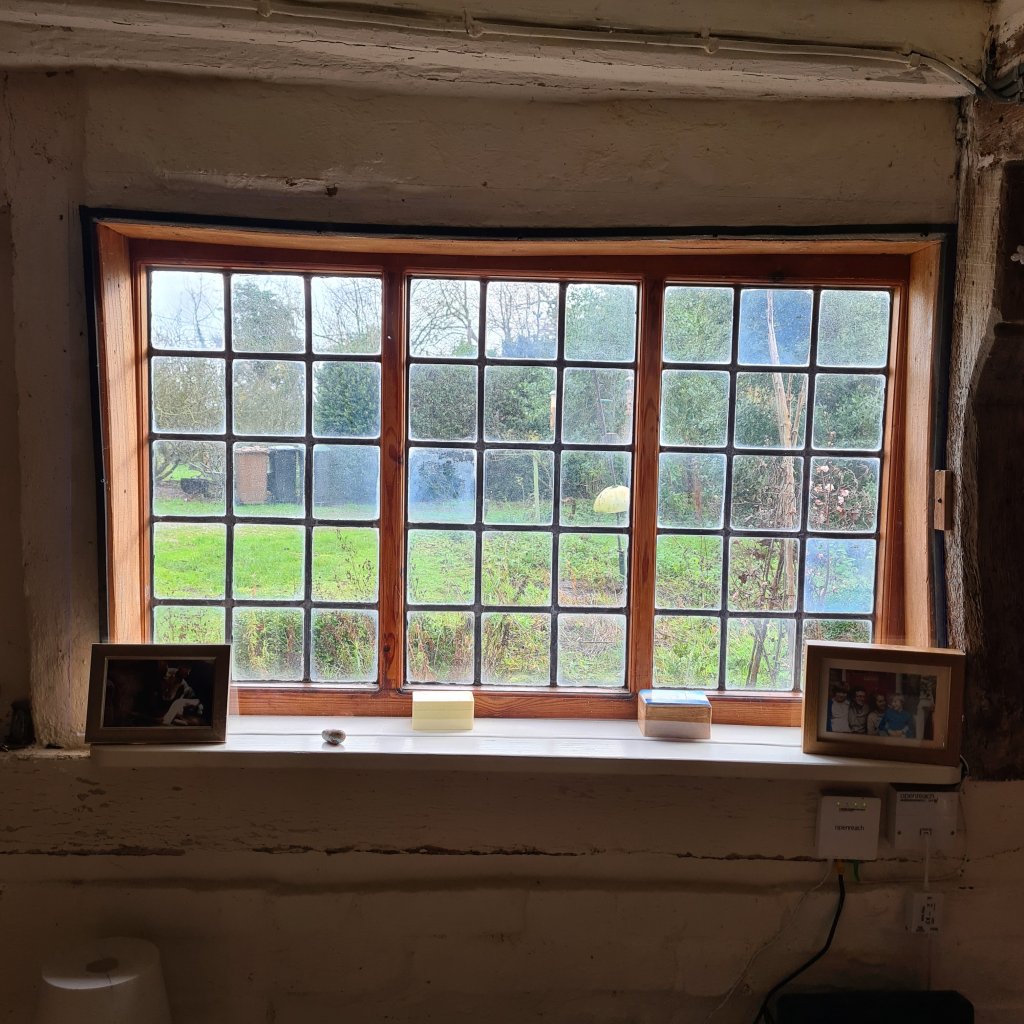
Energy prices have finally pushed us into doing something we’ve talked about for years – installing removable secondary glazing on the windows. In our case, this is worthwhile for draft proofing as much as for improved thermal efficiency, because we have 7 leaded windows, which are leaky, and impossible to seal any other way.
Secondary glazing needs to be light, easy to carry and hard to break, making it safer if we want to take it off for storage in spring and reinstall in the autumn. It turned out to be quite simple to do, using sheets of solid polycarbonate cut to size by the supplier.
The polycarbonate sheet is hard to see on this mullion window
The great advantage of polycarbonate in a crooked old house is that it’s far easier to drill and cut to shape than glass. In our case, that required several curved cuts to fit against ancient oak posts and beams, which I’d hate to try with glass.
Polycarbonate is also half the weight of glass, just as transparent, and very tough indeed. The disadvantage compared with glass is that it is easily scratched by rough handling or careless cleaning if you don’t follow guidelines. But those problem are far outweighed in our case by the advantages.
There is another choice, clear acrylic. This is similar to polycarbonate, which was not far short of twice the price, at just under £50/square metre against around £26 for acrylic.
Polycarbonate is much the strongest. It’s a bit less easy to cut and drill, but its UV resistance and much greater strength – needed for regular removal and reinstallation – made it worth spending more.
At first, we thought we’d need to build wood frames to support the polycarbonate. We bought a 3mm thick sheet for one window as a trial, and it was clear immediately that the polycarbonate was stiff enough to mount without a frame.
Thought needs to be given to how to fix the sheets and that will vary with preference and type of window.
Nine windows in the old part of our house are old and irregular, eight of them with oak mullions, one of which is already well insulated.
Polycarbonate on a 19th century window
After playing around with the trial sheet, much the easiest solution was simply to screw it to the window frame, accepting that the small holes would be visible when the glazing is removed. This worked with both the mullion and the more modern windows.
A complication is that it is advised not to drill holes less than 40mm from the edges of the sheets, or it could produce cracks. So where the window layout does not allow a good overlap of the sheet with the frame, another method is needed. The simplest is to hold the polycarbonate against the foam with removable battens.
This short piece of wood was enough to hold one side firmly against the draught-proofing foam
Given the sheets’ stiffness, the battens do not need to be continuous all the way round. A few short ones or small, swivelling toggles would do the trick, depending on the exact design of the window. Others may come up with different solutions.
Next question is how to make a seal between smooth plastic and the frame. Our solution was ordinary foam draftproofing strips with adhesive backs, stuck all the way round the edges of the sheets.
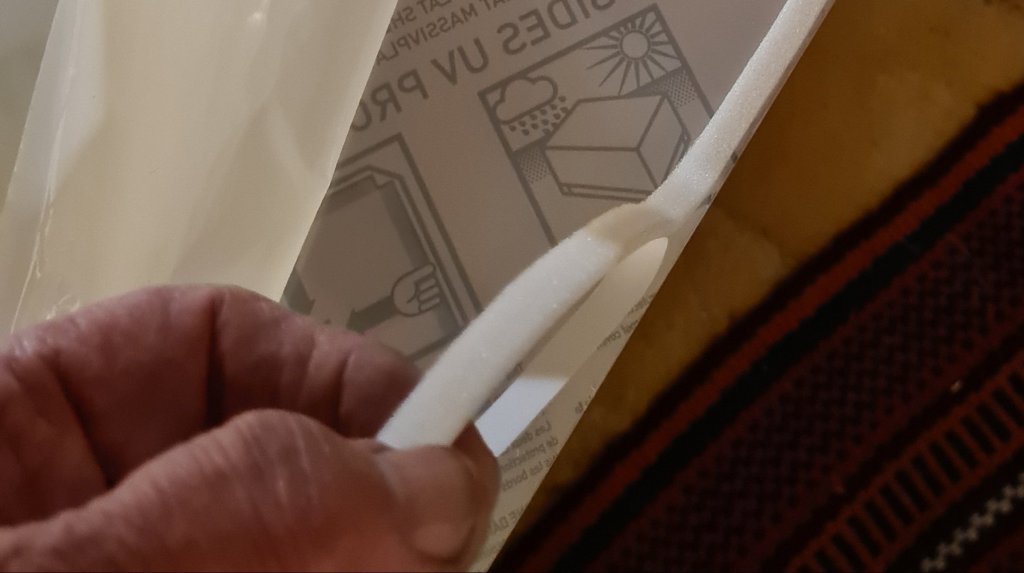
Applying draught excluder to the edge of the sheet. While working, leave most of the protective film on the polycarbonate sheet till the last minute, peeling back just near the edge to applythedraught excluder.
For the Victorian and more recent windows, where the timber surface of the frames is flat, white 5mm foam was enough. For the irregular oak timbers framing the mullion and other windows, we used brown 10 mm draftproofing strips.
The technical advice sheets say use new and very sharp drill bits for the holes to avoid cracking or overheating.
Tighten the screws evenly, each one a little at a time, as you go round the perimeter, several times. Tighten as little as possible, or the polycarbonate will distort. They need to be just tight enough for the foam to make contact all round.
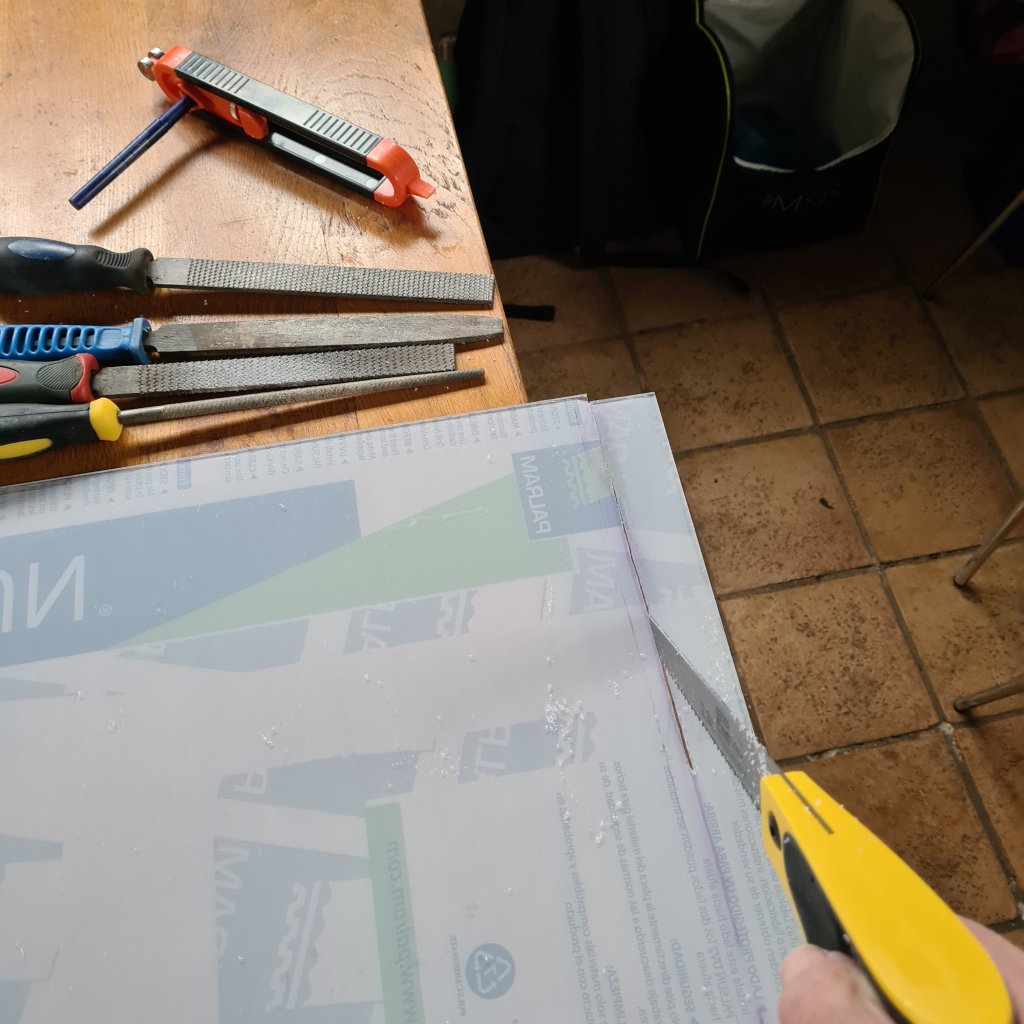
Using a fine saw to trim the sheet, leaving in place the protective film on both sides. A scribing tool was needed on this sheet to mark a gentle curve.
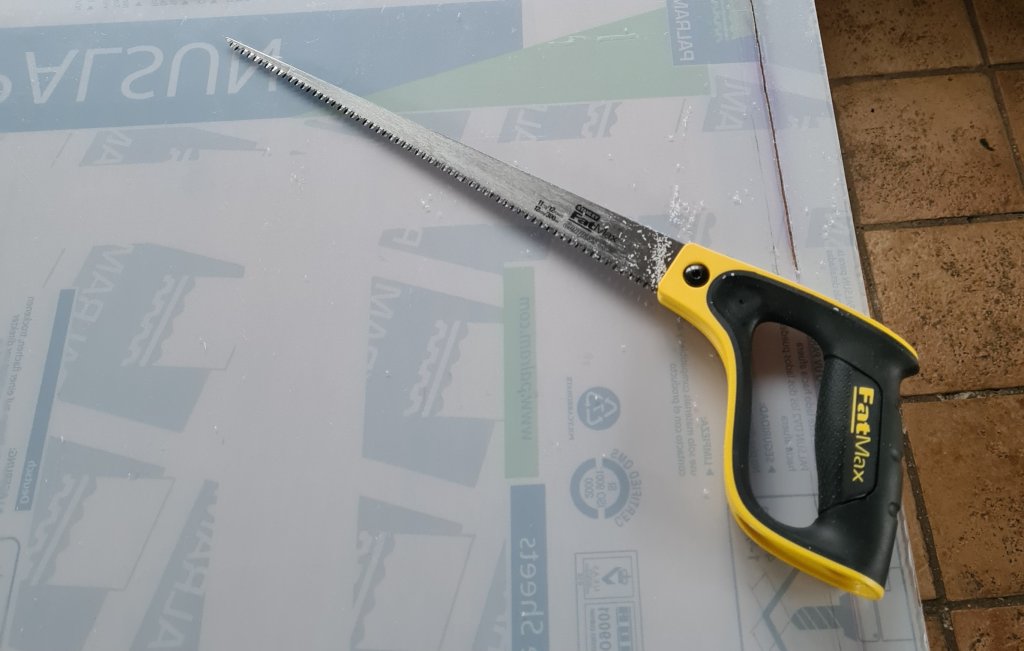
Some trimming of the sheets may be needed if the window frames are not square; if done with a power jigsaw, then a specialist blade for plastic is required, to avoid melting the material. In fact, it was easier to use a new, sharp handsaw, as we did not have much cutting to do.
This saw cut shallow curves quite well…..and this very fine-toothed saw worked well for straight cuts.
Fine adjustment of the shape of the perimeter can be done with a sharp flat file, though make sure the sheet of polycarbonate rests on a clean, flat surface while you do it.
The sheet comes with a plastic protective film on both sides, to peel off just before final installation – it is important to leave it on as long as possible. The type we bought has ultra violet protection on one side, and that should face outwards. The correct side is marked on the film. Some later sheets had UV protection on both sides.
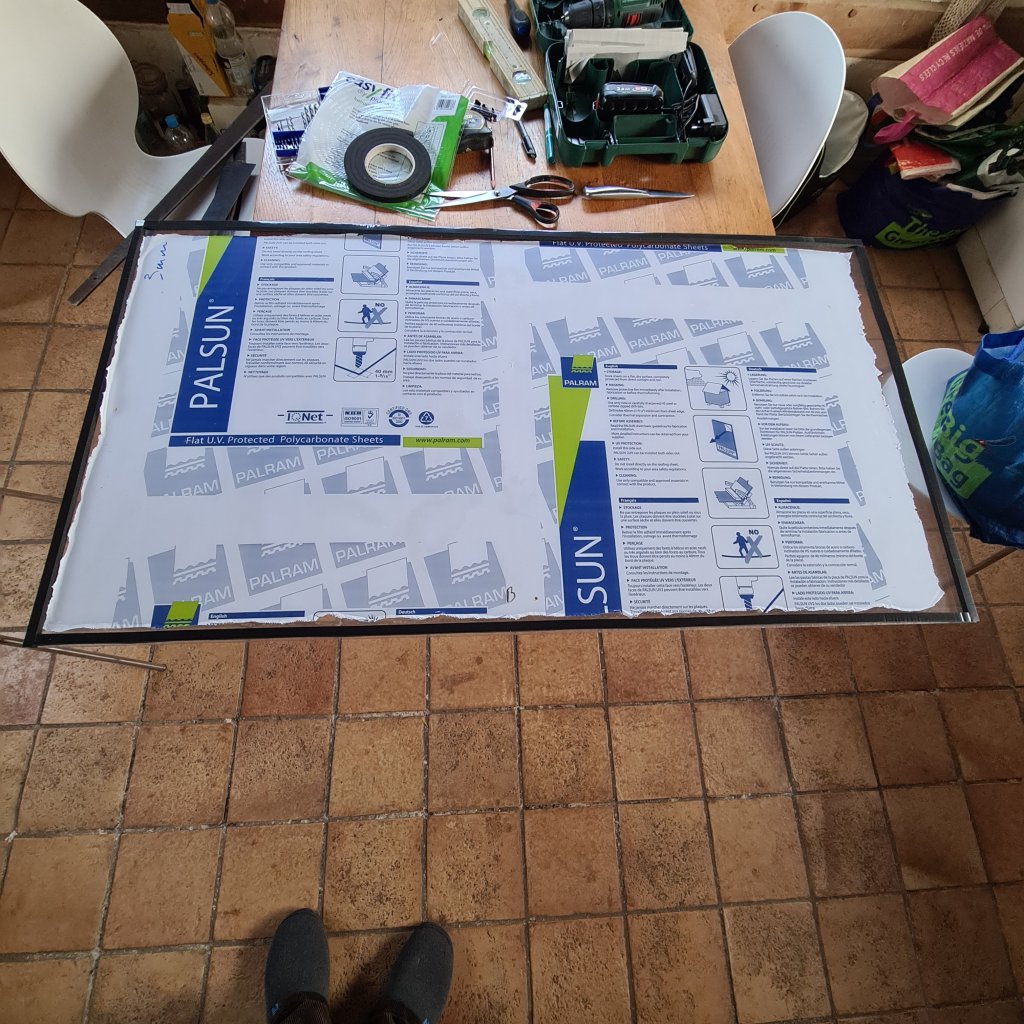
Sheet with protective film still in place, ready to screw to window frame. Here black draught excluder has been applied all round the edge.
Because polycarbonate is stiff, we found 6 x20mm screws at around 250mm to 300mm centres were an adequate size on windows where the sheet rested on the window sill and 5mm foam was used.
Where the sheet used 10mm foam (on rougher oak surfaces), and had no support from below, we used 8x25mm screws. We used zinc-plated steel screws on white-painted windows, and round-headed black japanned where we screwed into dark oak timbers.
An old oak window with polycarbonate fittedusing black draught excluder. (Three mullions are missing from this window).
The cost averaged at around £60 a window, including a modest amount for draughtproofer and screws. Our supplier, which delivered accurately cut sheets on time, was https://www.thepolycarbonatestore.co.uk
Be very careful cleaning polycarbonate, because it scratches easily, even though it is hard to break. I made a mistake on one window, cleaning it with an ordinary wet cloth and not noticing grit had fallen from the limewash wall above. I found tiny scratches, luckily much less obvious than the distortions and scratches on the old Victorian glass of the window behind. Your supplier should have advice sheets on cleaning: stick to what they say. Some everyday cleaning products and cloths can damage polycarbonate and it should not be wiped and dusted with dry cloths.
Apart from the sill, none of the sides of this window are straight, so trimming was needed.Detail – the sheet and foam fitted neatly upwards into the slot in the beam above this mullion window, along which the old wooden shutters used to slide. We have one complete workingexample of a traditional shutter, so that window does not need polycarbonate.
We had planned to remove the polycarbonate each spring and reinstall in autumn but, on reflection, there’s not much point on the mullion windows as they cannot be opened. So these will only come off for cleaning. Polycarbonate on opening windows will go in the garage for summer storage.
Keep any cardboard sheets the polycarbonate is packed in. It will be useful to protect them during summer storage. I also kept some of the protective film, in case any sheets turned out to need more work.
And finally,there is a great deal of information on line about secondary and double glazing. For modern double glazing, optimum air gaps are no more than 20mm, beyond which convection begins to remove some of the benefits.
For a complicated listed building like ours, secondary glazing can only be fitted in practice with much larger air gaps, of 50 to 150mm, so thermal performance cannot be anything like as good (though noise insulation is improved, if that is what you need – but we don’t).
I can’t quantify the heat performance of our secondary glazing, and anyway it would not tell us much if we knew.
That’s because an unquantifiable part of the heat loss is through the leakiness of our old windows, especially our 7 leaded windows, which have draughts around many of the small panes, and I cannot see any other simple way of stopping that.
All I can say is that there was an immediate improvement in thermal comfort once secondary glazing was installed, from a combination of reduced draughts and improvement in thermal efficiency.
PS One way to judge which windows in an old house are leakiest is to see how many spiders webs are on and around them. Where there are draughts, spiders put webs, because draughts help them catch prey more effectively. Till installing the secondary glazing, our leaded windows have had to be cleared of webs every couple of weeks. Spiders are ineradicable from a 16th century house, though thankfully ours are mostly the tiny bodied, long-legged but innocuous looking Daddy Longlegs.
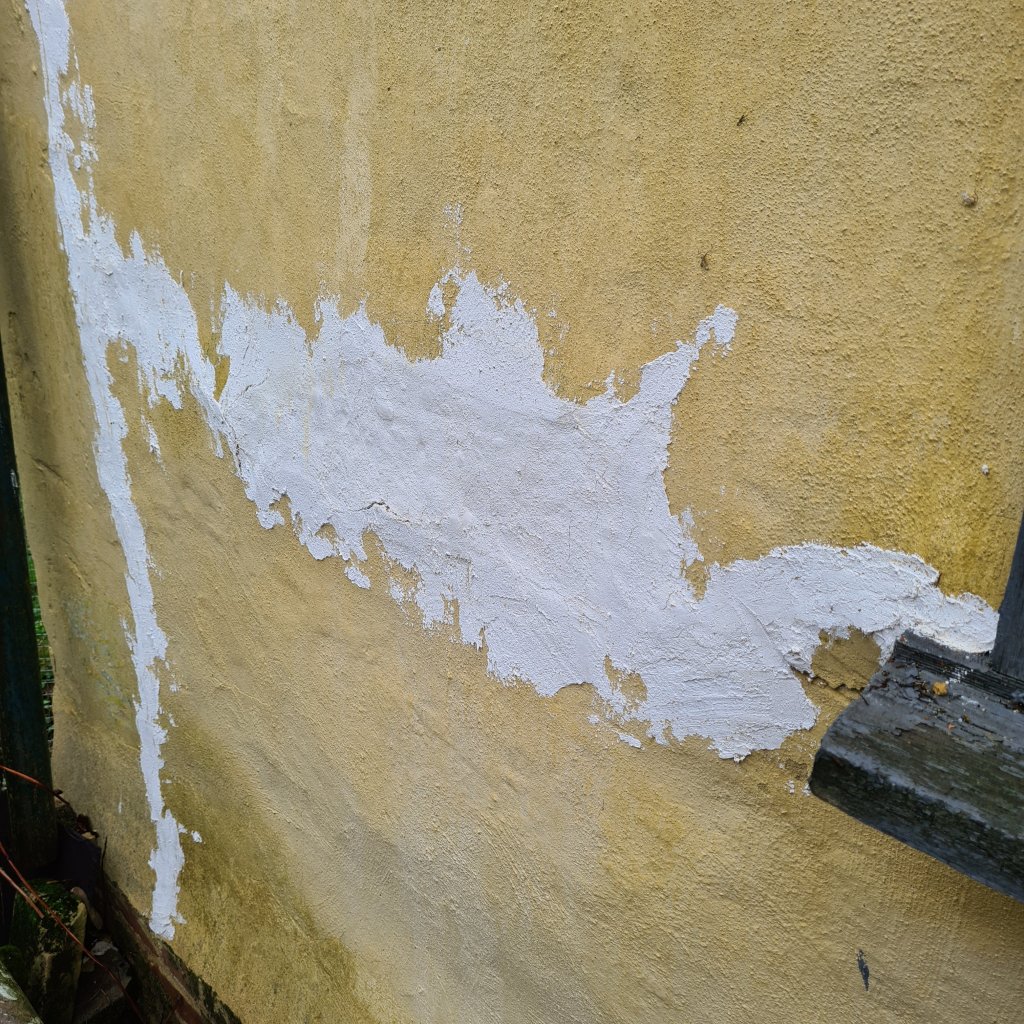
I’ve just done a few pre-winter repairs of the outside walls in spots where surface render has lost its grip on the clay daub beneath. To my surprise, chalk lime plaster bought in 2014 is still usable.
It appeared to have solidified under an inch or so of water. But after scraping at the surface it quite quickly began to recover its original consistency. Lime putty when stored properly lasts many years – I still have an old tub of it in good condition – and this plaster is simply putty, chalk and fibre.
It is not entirely traditional: it uses synthetic fibres and they last indefinitely in the tub, unlike haired plaster, where the hair begins to disintegrate after a month or two.
Chalk-lime plaster – quick repair ahead of the winter
The old plaster is not ideal, because it takes hard work with a trowel to get back to the right consistency. But having forgotten to order a new tub, it’s good enough to protect small areas of exposed clay from rain and woodpeckers for a while. Next, I must order a new tub.
Chalk-lime plaster used externally has proved extremely effective over the years in temporarily patching areas of old wall that we haven’t fully repaired yet. A thin layer behaves almost like a sticking plaster over the cracks where old render is beginning to come away from the wall. Once cured, it has considerable strength and resists tearing.
There’s one quite large patch where the old render has almost entirely lost its grip on the clay – tapping reveals a hollow behind – but plaster over the cracks has kept it in place for the last few years.
It’s admittedly a bodge, but we wanted to delay full repairs as long as possible while effort and money went into other priorities. In due course the whole of one gable and about half of one wall still await a full overhaul.
Both will be a challenge. In the days when our house was part of a farm, a lot of running repairs on the clay were done with cement render. A bit less than a third of the walls is still cement render. The rest is our past repairs and some areas of wall that have been untouched for many years.
The latter are not even rendered, but are clay daub covered with many coats of limewash over a long period. The limewash has built into a thick layer that, until we examined it closely, we thought was in fact a render. So our farm building’s exterior walls may once have been rough clay daub given a protective limewash.
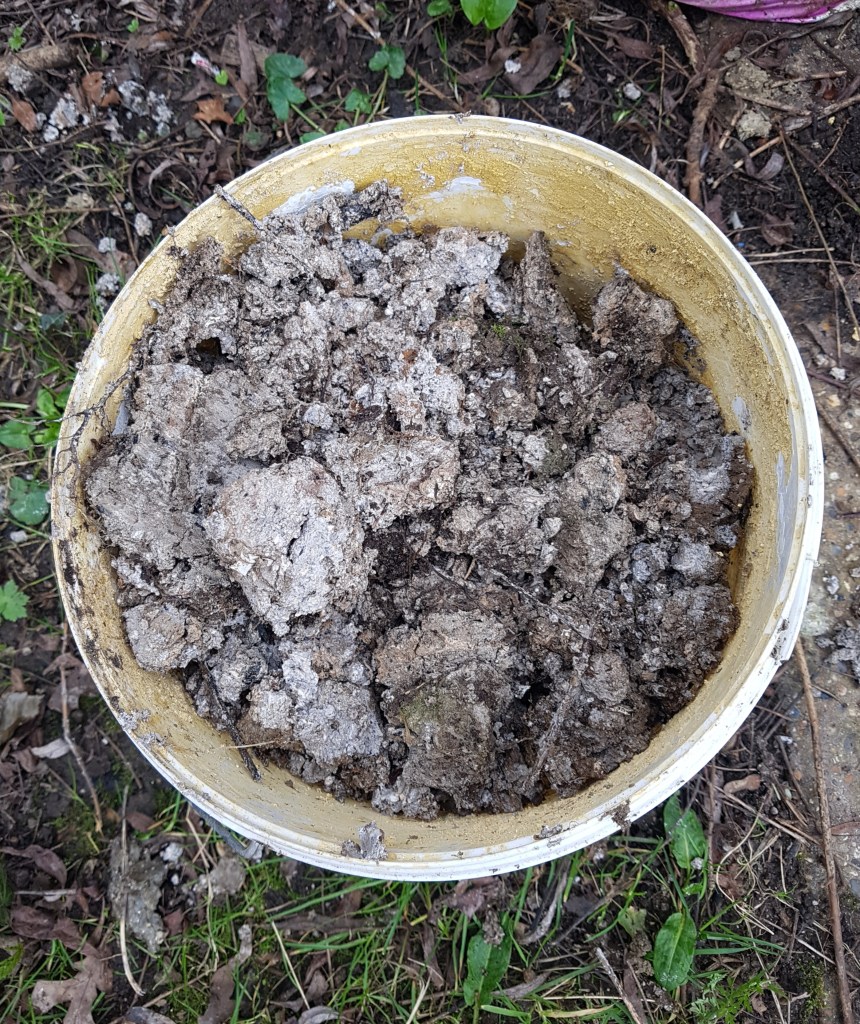
This unprepossessing grey mess I collected in a bucket is boulder clay. If you’ve got a house with clay walls, it’s like finding a seam of valuable minerals. There’s no clay to beat it.
Our part of Suffolk mostly sits on thick layers of the pale grey, white-flecked natural building material, laid down by glaciers grinding their way over chalk. But it’s usually deep down and hard to find.
It comes near the surface here, because that’s why our pond exists, sitting on an impermeable bed of clay. But it’s not so easy to dig out without draining the pond, which we think was once a clay pit.
Digging a trench to plant a hedge yesterday I kept finding lumps of it, deposited there after earlier work on the pond. It has got muddy, but that doesn’t matter – a bit of earth won’t spoil its performance.
Not only does it make a good, plastic clay for wall repairs when mixed with straw, it is also less prone to shrinkage cracks than ordinary yellow clay, and dries as hard as a lump of chalk.
If you have clay daub walls and come across any, store it till you need it. Wonderful stuff.
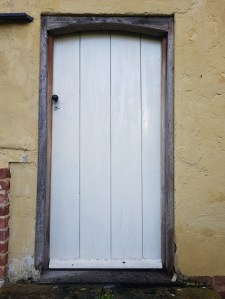
This nice door was made for The Old Brewhouse when it was a farm service building where nobody lived.
It has thin planks with cracks between, and is a heat sink in the house during winter, no matter how much draft proofing is stuffed in and around it.
As a listed building, we’re supposed to make a formal application to the council heritage department and pay a fee if we wish to replace it. Our solution was to leave the old door untouched, apart from a few new screw holes, and build an identical door on the inside of it to double the thickness, cover the cracks and improve its thermal performance. It should make a noticeable difference to the warmth of the room in midwinter.
I’ve just laid 35 feet of new drain from the house down to the pond, and discovered a layer of what seem to be 18th or early 19th century drains, of a type that a little internet research discovers were named horseshoe drains. I have often noticed, whether at Greek ruins or at Norman Castles, that the remains of old drain and sewage systems fascinate visitors, myself included, so the annoying fact that one of our key drains was totally clogged with tree roots at least produced something nerdishly interesting. Continue reading “Ancient drains”
What wood is the floor made from and how old is it?
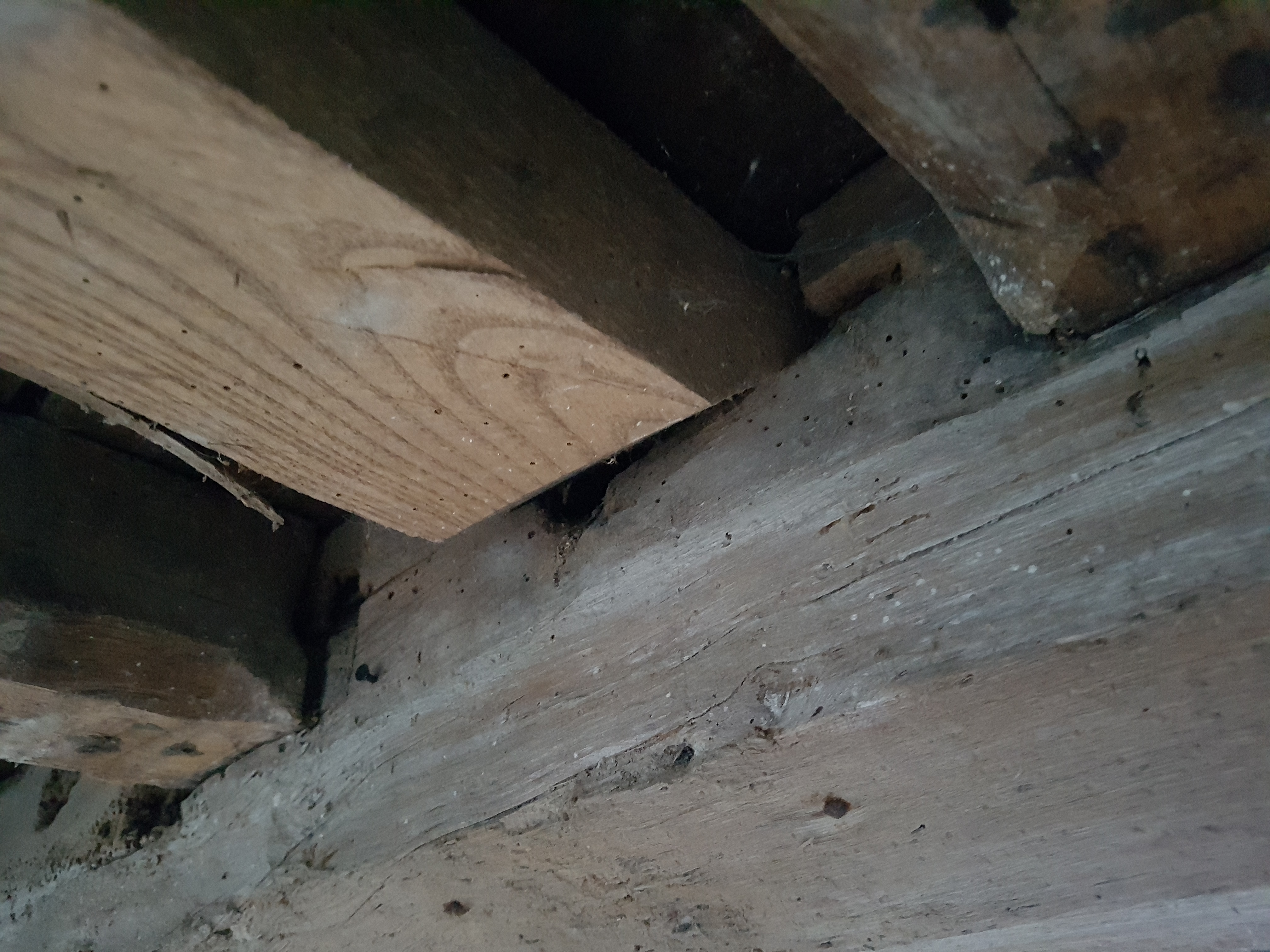
Clue (1): an extra pair of joists made of ash, not the usual oak, have been inserted crudely either side of the central beam, with notches and wedges instead of a mortice and tenon.
I go into a great deal of detail in these floor posts, on the grounds that if you’re interested in repairing a very old floor you’ll need it; for the rest, read no further! Over the years it’s the blog posts like this that seem to be read most, I assume by people doing similar jobs.
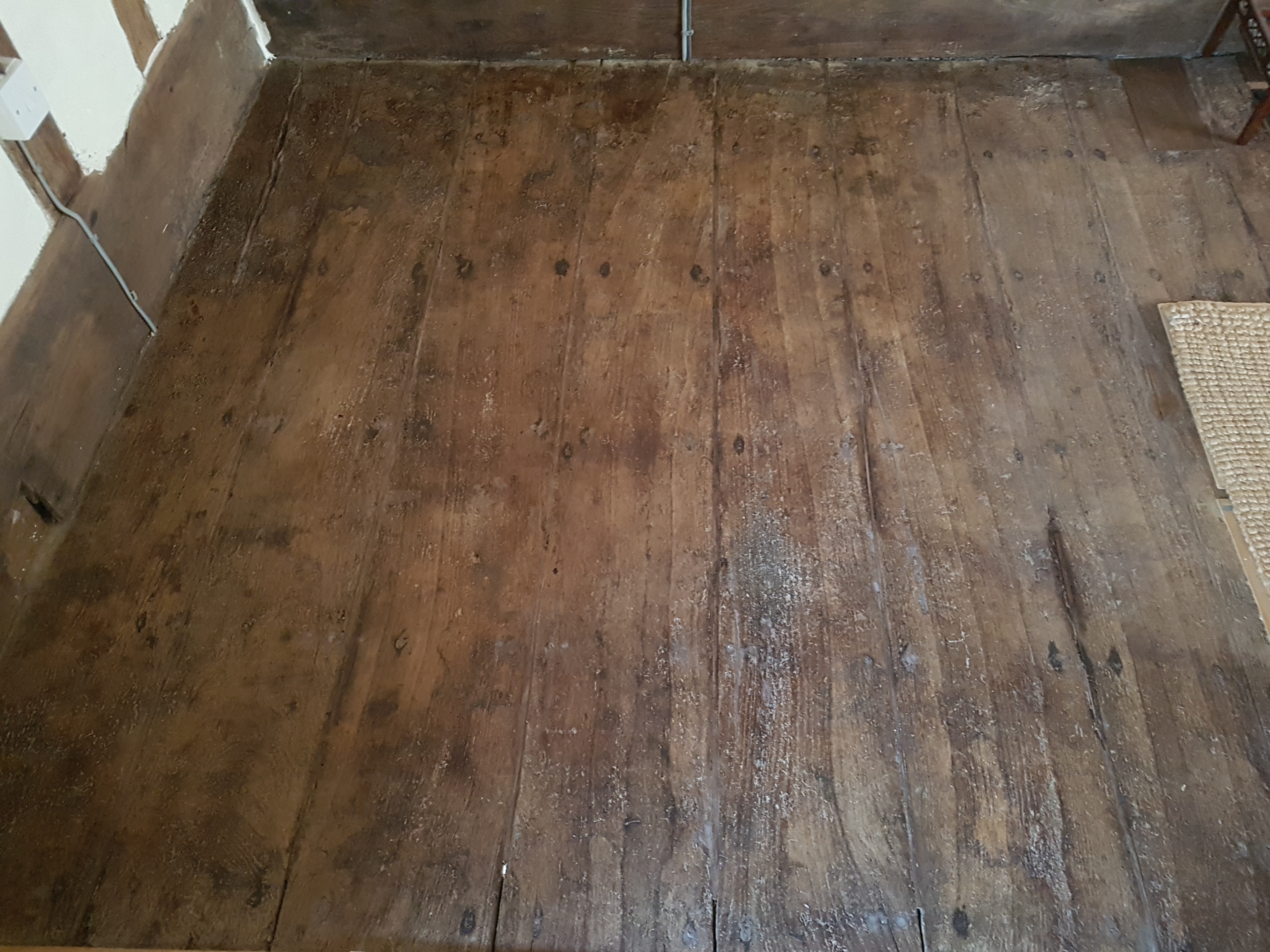
Rotten sections, weakened sections, blackened, stained and crack and holed sections – the whole messy old floor came together into one attractive, if battered, whole, once beeswax polish was applied.
It’s great what a coat of beeswax can do for a damaged floor.
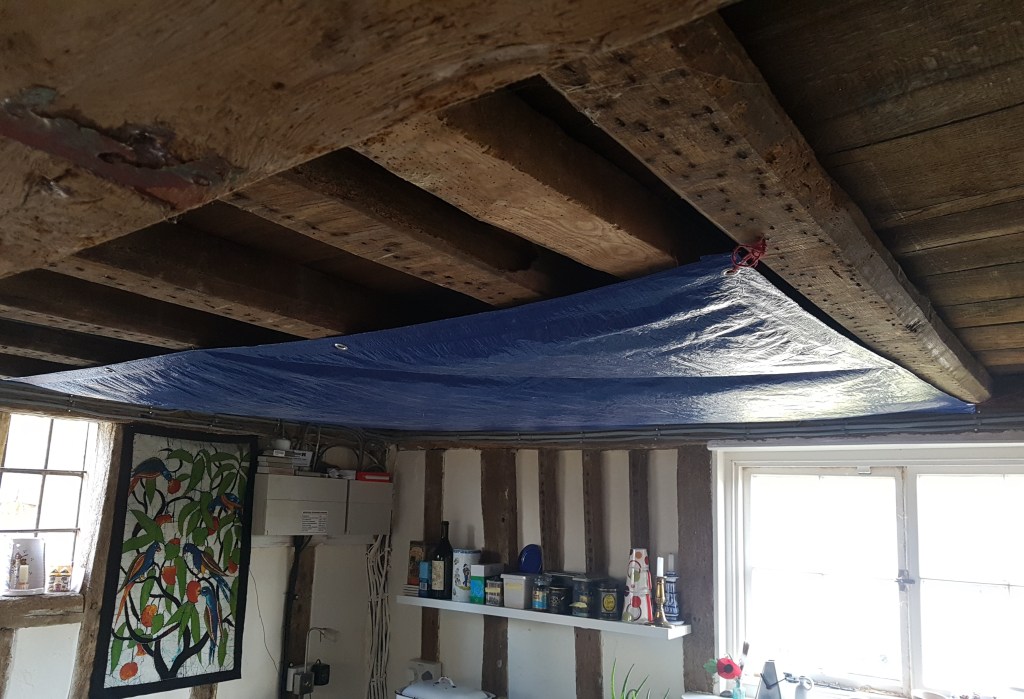
The first thing to do was to protect the room underneath from debris falling through the many cracks as we worked on the floor above. The solution was a plastic tarpaulin tied to the joists:
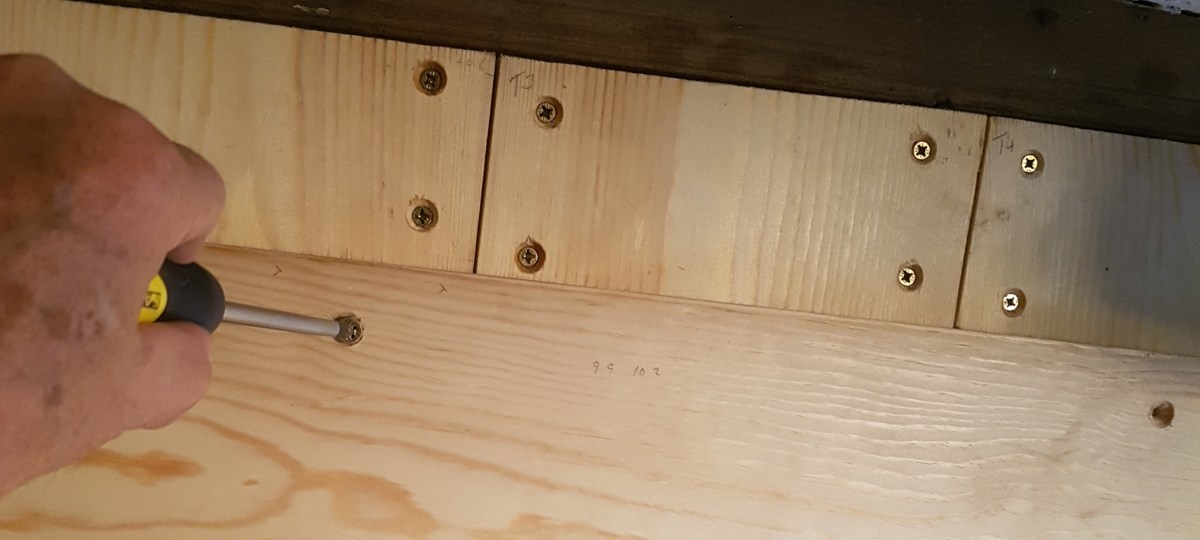
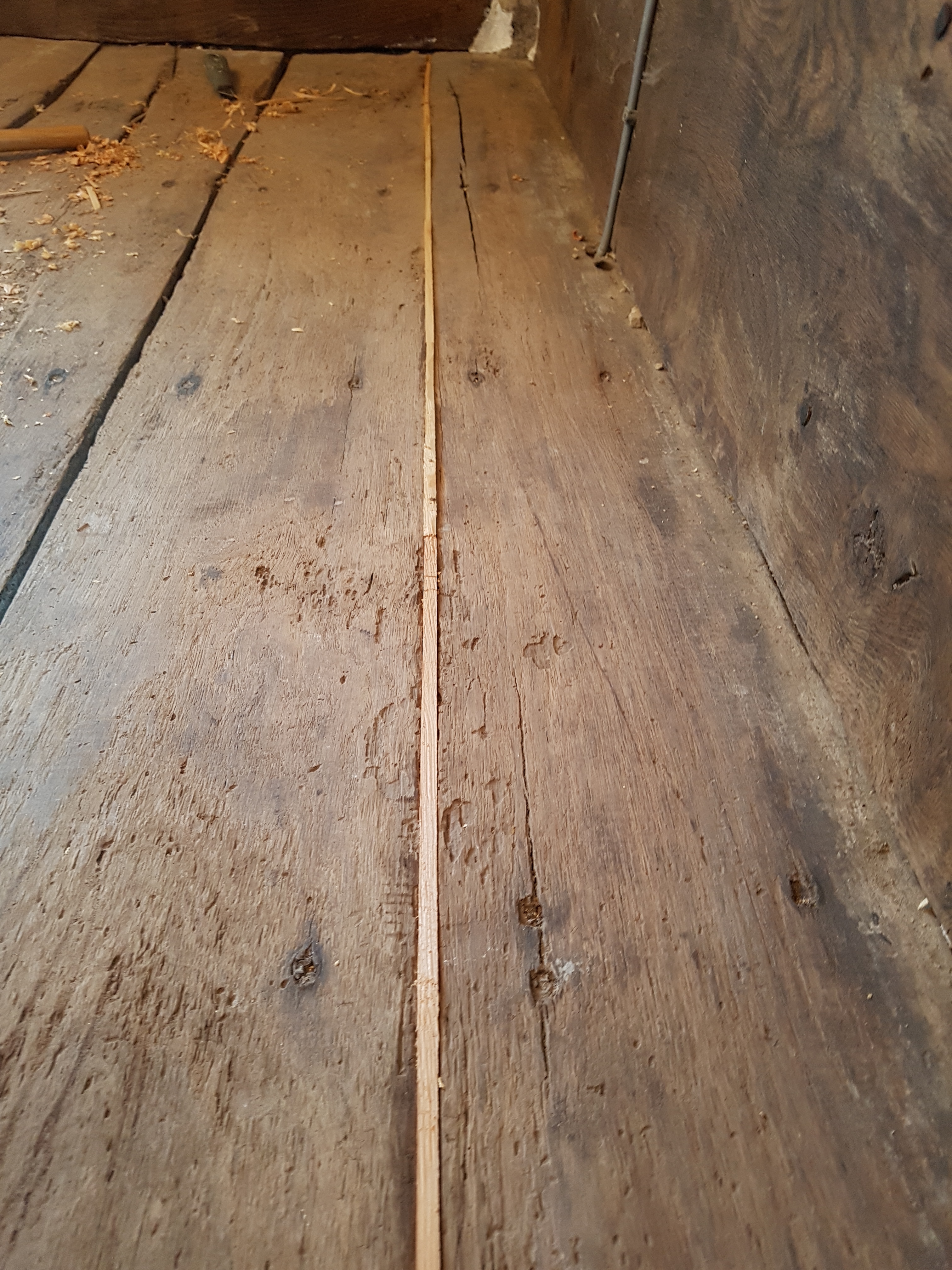
The second thing to do was to make sure the boards were firmly on their joists so not springy when walked on. There were two bad patches, where the boards had to be screwed down hard onto the joists to stop movement. Since the undersides were exposed, we were also able to push in wood spacers from below. Continue reading “Repairing the floor – 2”
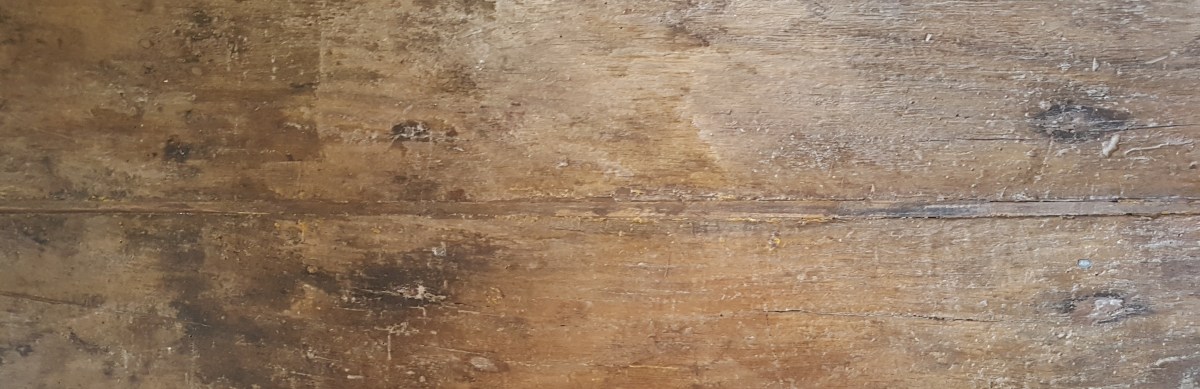
The floor we want to repair is of unknown age but must be pretty old, not just because of its battered state but because the boards are of uneven widths of up to a foot or so, presumably because they were cut from the same tree. Continue reading “Repairing the floor – 1”
And now for the next challenge, but I need to get fit first: does everyone get quite as stiff as I do when trying to work for long hours on a floor? It is the most uncomfortable position to work in, apart perhaps from plastering a ceiling, but we are about to start on repairing a lovely old floor that until now has been covered to protect it, so the pain will be worthwhile (I hope). Not entirely sure what it is, but think that it is oak or elm. More later, as we get going on the job next week.
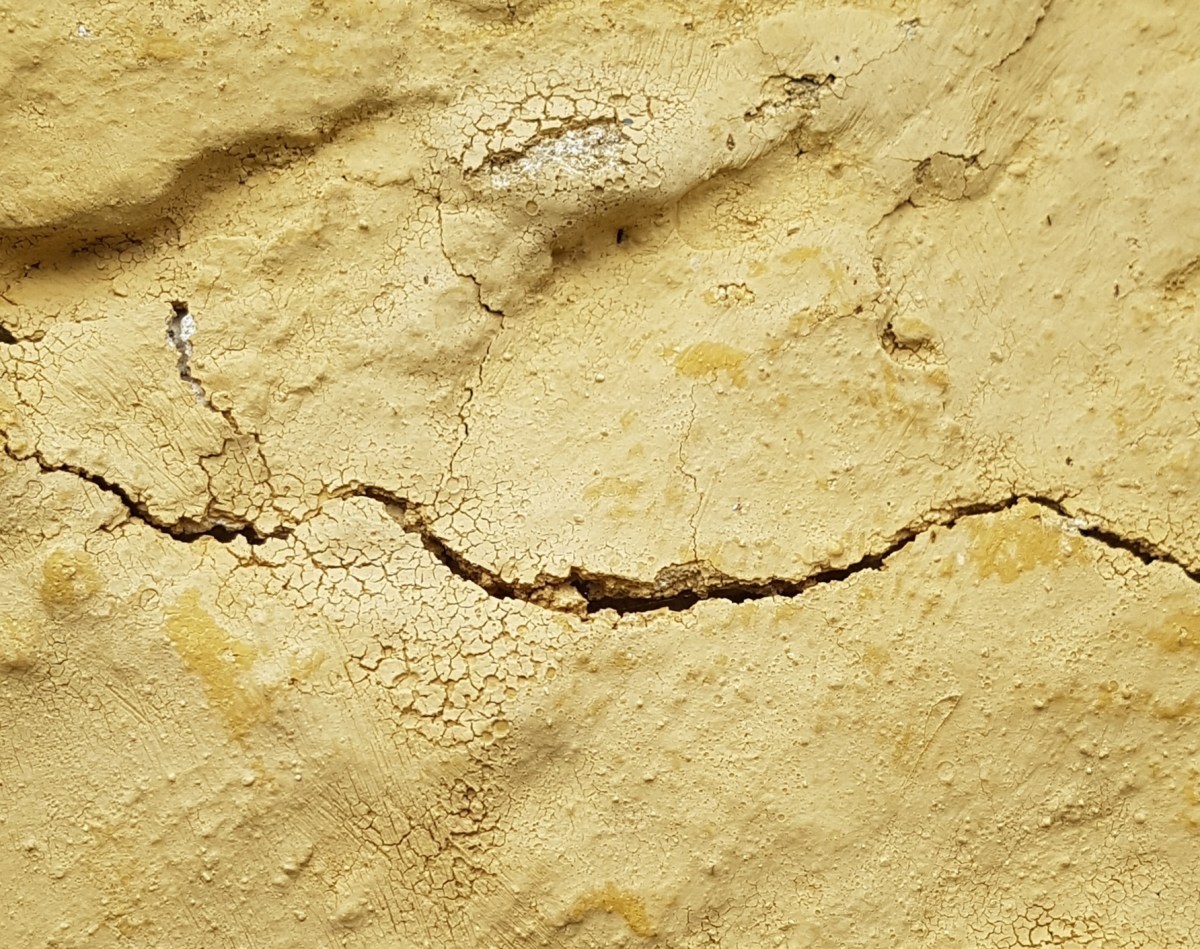
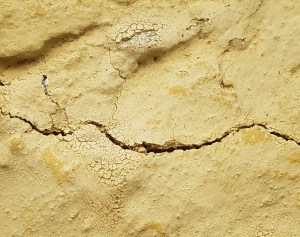
The hot, dry weather has produced many more cracks than usual in our front wall.
Much of it is plain clay daub with thick layers of limewash and here and there a smear of recent cement where previous owners had tried to stop the clay falling out. There is no evidence of it ever having been rendered or plastered on laths. Continue reading “Cracks”









 saving The Old Brewhouse