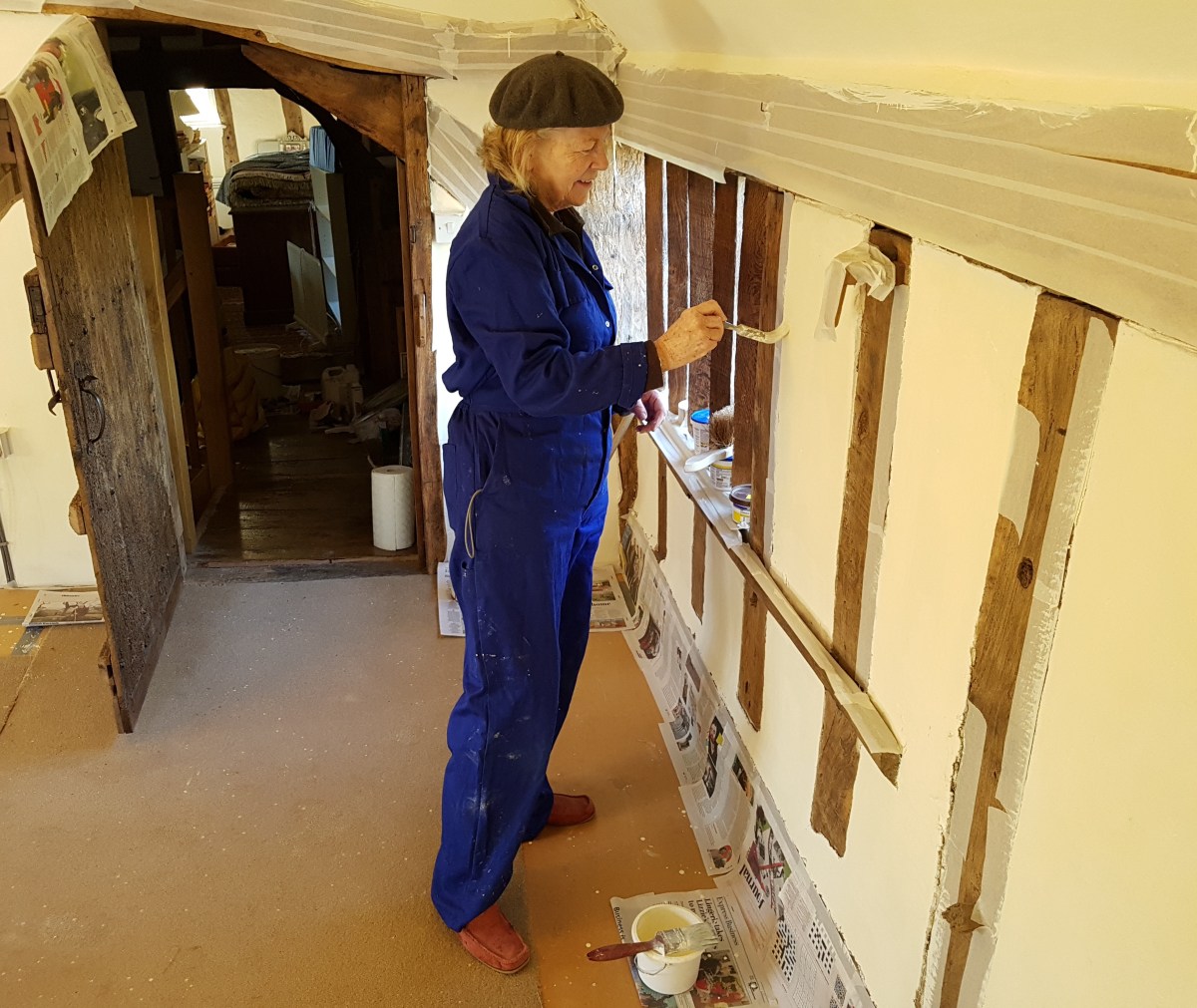

According to one Suffolk expert, limewash was not used inside homes. If true, then we’ve been doing it wrongly for years. Instead distemper made from chalk and milk casein is said to have been the covering of choice, so this winter we’ve tried it.
Room preparation is exactly the same as for limewash. We brushed down with a stiff brush rather than washed the walls, because there was no evidence of any greasiness. We then did all the usual masking of the exposed timbers using tape; for the wide horizontal beams and foot high skirting board we taped on old newspapers for greater cover.
The distemper was from the excellent Ingilby’s of Glemsford, with the cream colouring done while we were there – as each bit of yellow was added, a little distemper was dried on a piece of wood with a hair dryer until the cream looked rich enough. (I did not know that grey is also used in making a creamy colour). We were warned that it only keeps for a couple of months and is very smelly when it goes off, because of the casein.
The distemper was very thick and the first coat and indeed the second coat needed thinning to different degrees. We tried a little then a lot, and up to 20 per cent is advised for the first coat. The surfaces proved more absorbent than we thought.
The surfaces had been emulsioned, which at first we thought a disaster for breathability. But on reflection, after seeing the distemper sink in so fast, it must have been one of the old trade emulsions which various authorities say were quite breathable compared with modern products. It is very good to know that the emulsion has not ruined the breathability.
Unfortunately some of the plaster panels have been repaired with a skim of cement but experience in other rooms suggests it is more destructive to try to remove it than to live with it. When we tried to get it off clay and lime elsewhere, there was disintegration.
Application is not like limewash, which you almost literally wash on with the brush. Distemper in contrast has to be brushed out like an emulsion, and the final laying off strokes need to be done in the same direction like a modern paint, or odd patterning appears when lit from the side.
An advantage is that it needed only 2 coats rather than the 3 for Ingilby’s linewash though one particularly absorbent and marked surface needed three. However, given the greater amount of brushwork needed, I do not think the time advantage over linewash is as large as two coats suggests.
The previous owners, when The Old Brewhouse was a farm service building, had plasterboarded the ceiling in this room and also put in plasterboard to make a partition for the bathroom, and we have not tried to alter this. Distemper did in fact work well on the plasterboard.
Overall the room shows a splendid amount of old timber, including a foot-high skirting board, and most of the plaster in the wall panels on the three outsude walls of the room are old plaster. There are four mullion windows in the room.
There is also an oak floor with very wide planks which we think must be very old. Next job is to expose, repair and beeswax it. At the moment it is protected by hardboard and carpet.
 saving The Old Brewhouse
This is so interesting! I opened this post because – thinking distemper was a disease – I wondered what it had to do with traditional renovation methods! We live and learn – good stuff!
It sounds like i am being quoted here.; not using lime wash inside a timber-framed house. That has been my observation of most early internal surfaces. I am glad to hear that you have found distemper suitable, however you can easily mix this yourself with size and pigment and you only ever need one coat, not two. i think i noted the mention of casein and there is no need for this in the mix. Casein paint is a coating in itself. Timothy Easton, Bedfield Hall, Bedfield (open for inspection on Invitation to View or Historic Houses). Come and see for yourself.
Thanks for your reply. Have you written for the SPAB magazine? Your name is familiar, but I can’t remember where I first saw the comment about indoor coatings. We don’t need to do any more inside for a while, but I will probably use distemper when needed because it’s such an easy and pleasant material to use, and the surface it produces has more tones in different lights than limewash. This is a small cottage, so once decorated it’s done for a few years. I’ve looked at your home on line and at some point it would be good to join one of your tours to find out more.
Yes correct and you can find others on the Academia website. The forward blurb is not mine Best Timothy
Timothy N D Easton
Academia.edu https://independent.academia.edu › TimothyEaston https://independent.academia.edu/TimothyEaston Timothy N D Easton studies Archaeology/witchcraft/Magic, Archaeology of Caves and Caverns (Archaeospeleology), and Archaeology of Occult Practices. You’ve visited this page 4 times. Last visit: 02/08/2023
Timothy Easton https://independent.academia.edu › TimothyEaston1 https://independent.academia.edu/TimothyEaston1 Timothy Easton studies Feminist history, Medieval England, and Medieval Women. NO HE DOESN’t. SOMEONE TRYING TO BE FUNNY
Some Buildings of Debenham (Timothy Easton) – YouTube
YouTube https://www.youtube.com › watch https://www.youtube.com/watch?v=qzv22yS3Ck8
40:57 https://www.youtube.com/watch?v=qzv22yS3Ck8A talk by Timothy Easton given at ‘East Anglia Vernacular Buildings’ (VAG Spring Conference, 17 April 2021) YouTube · Vernacular Architecture Group · 23 Apr 2021
10 key moments in this video You’ve visited this page 2 times. Last visit: 07/07/2023
>